Wednesday, August 16, 2006


I have a flight tomorrow to Cochrane, Ontario. I thought I was free from the north, but no such luck ;) We are going there because our company owns a facility in the area and the bosses want to take a look. The parent company I work for owns nearly 90 facilities all across Canada and the US, so that's the main reason for having our aircraft. Well, that and taking the bosses on vacation. I should read up on my uncontrolled airspace procedures as I really don't deal with that very much any more. I have been into Cochrane, it's not a bad little strip, but it is a little bit 'rustic'. Once we land I'll have to get myself and the other pilot a couple of hotel rooms as we'll be there for 8 hours and the last time I went into Cochrane, the terminal had a payphone, a couple of chairs and that was it. I would rather not spend the day huddled in the airplane, venturing out to pee on a nearby tree, and I figure a couple of hotel rooms is a smart part of the total cost of the trip. I hope the hotel restaurant is good :)

Speaking of food, let's go back to 1997 when I worked in Stony Rapids and flew the Navajo and B-55 Baron. Life was cheap, but food was expensive and I was paid nearly nothing. 2l of milk was like $6, and a small box of granola bars was the same. We had an arrangement with Air Sask (now part of Transwest Air) that if they had spare room on their daily scheduled flights from La Ronge, we could put our groceries in the hold and get them shipped from La Ronge, where the prices were a little lower, to Stony Rapids. However that hardly ever worked without a hitch - usually our food would get bumped for paying cargo, and when it arrived a few days late, the green stuff would be brown and the brown stuff would be green, etc. Lots of pilots would load up the airplanes with fast food if they had a trip returning north from 'down south', and there was a black-market economy in Stony for Kentucky Fried Chicken ($5/piece) and McDonalds ($5 for a basic burger) and Pizza Hut Pizzas ($25-50 for a pizza) but again I made almost no money, so that sort of stuff was beyond my reach most of the time. I didn't like being hungry much, so along with most of the other pilots, I learned how to supplement my diet with the pentiful (and delicious) fish caught from the local rivers, from Northern Pike to Pickerel to Arctic Greyling to Lake Trout to just about anything I could catch that had gills. The fishing there was truly amazing, and it was unusual if you didn't catcha fish with every single cast of the rod. I'm not kidding. A local electrician named Dean (we called him Sparky), taught me to fillet a northern pike in 2 easy steps so it was boneless and skinless, and I ate fish with just about every meal. One of our fellow pilots built a smoker out of an old refrigerator and when the trout ran in the fall, we'd put the fillets in the fridge and build a fire nearby, funneling the smoke into the fridge using some old furnace ducting. Smoked lake trout is a little chunk of heaven, and I'm guessing a single taste would turn the most hard-core PETA activist into a drooling, fanged carnivore.

We had a routine that after 5pm most of the pilots would go down to the waterbase in Stony Rapids where the Beavers, 185's, Otters etc were based, we'd take a company aluminum-hulled boat and putt out a few hundred yards to catch our suppers. That sounds idyllic, right? That's cause I haven't mentioned the bugs yet. I had never seen blackflies until I moved to Stony Rapids, and after the first summer I had a deep respect for their ferocity. You can't actually feel them bite you, I think they inject anaesthetic, but they take a big bite and you will actually see blood run down your face after a bite. They also head straight for your eyes and nose and ears, adding to the fun 'cause they would happily crawl directly into your brain and suck out the contents if you let them. Most insect repellents were completely ineffective, and they basically only served as a marinade.

Here's a guy after only a few bites. Keep in mind there are literally millions of blackflies per square km of space in the north.


Enter the bug jacket:


Wtf is a bug jacket? Well, it's a light shirt that has a fitted elastic waist, elastic cuffs and a mesh shroud over the entire head of the wearer. It also has mesh under your arms (for ventilation in summer). It's a lifesaver cause it prevents you from losing all your blood to the little beasties that would gladly suck you competely dry in a few minutes. To go with the jacket you'd usually want a pair of good gloves, for complete protection.

So we'd get on our bug jackets and go fishing. Now here's the freaky part: If we didn't catch a decent, sizeable fish within the first few minutes we'd generally come back to shore and go inside. Because the sheer amount of blackflies that landed on us while we were fishing would make us look like we were covered in mud, and the sound of their buzzing, even though we were protected, would eventually freak us out. After a few minutes of sitting in the boat, we'd have maybe a pound or so of blackflies on each of us, with each one weighing a fraction of a gram. Fortunately the first frost of the year would kill them all, and the first frost came early up north, but it was still an adventure every time we went out of doors. I can't imagine how the original inhabitants survived before the wonder of nylon mesh.

Anyway, it wasn't long before we were all quite sick of fish, and were constantly scheming ways to add new and tasty things to our diet. Caribou were very delicious, and if we flew the locals on caribou hunts they would usually give us a big chunk of meat, but that was only in spring and fall. So we focused on the way we could eat like rich people: the uranium mines. Most of the northern economy in Saskatchewan was/is uranium mines, and the company I worked for, Northern Dene Airways, had the contracts for most of the mines. They employed a lot of local workers, so a few times a week we would fire up the navajos and bring workers in and our for their 7 day rotations. It was a sweet setup for us - we'd bring the workers there in the mornings, stay a few hours, and bring the returning workers home in the afternoons. That meant we got to stay at the mines for lunch, and they were legend for the quality of food they presented us. Cigar Lake was my personal favorite, but MacArthur River and Cluff Lake were also fantastic. Sometimes we would even starve ourselves the night before so we could fit more in our bellies at the mines. They had chicken, roast beef, pork chops, lasagna, ice cream, chocolate milk - FROM A DISPENSER!, salad where the lettuce was the right color, potatoes, steak, carrots, fresh bread, cookies, cake, and more. I remember the first trip I did, sitting in the Cigar Lake cafeteria, 250 miles north of any road, and eating black forest cake after my meal of roast ham. I think I may have wept with joy just a little bit.

I'm not ashamed to say that I would bring a clear ziplock bag along with me and put some of the goodies in my pocket, for snacking on later that night. Before we left the mines we would also ask for a boxed lunch, which had great sandwiches, fresh fruit, veggies and dessert. That meant that a single trip to the mine would feed us for that day and most of the next day, and we fought viciously for the mine run trips. After a while at Northern Dene Airways I was put in charge of the scheduling, and the other pilots routinely tried to bribe/threaten me to get the mine trips, even though we were all on mileage and some of the trips down south would pay more, just for the opportunity to eat like normal people did.

More about actual flying coming up...

Click on the pic to make it bigger. We did regular runs from all the northern communities to all the mines in this map.

Tuesday, August 15, 2006


That is Stony Rapids, Saskatchewan, where I had my first flying job. To the left of the 2 main hangars is a tiny building with a black roof, right on the ramp. See it? That was Northern Dene Airways' 'terminal', where I spent every day for a year until I was transferred to Uranium City, a hundred miles west. If you followed the main gravel road near the top right of the picture another hundred yards or so north, you'd arrive at the little red log cabin I lived in.

The next few posts will deal with the stuff that happened while I was in the employ of NDA.

Have you ever been upside down in a Navajo?

It was summer 1998, and I was flying back with Luke, a fellow pilot at Northern Dene Airways. I was in the right seat, and this was maybe my 5th or 6th flight in the mighty Navajo. We had dropped off a medevac patient in Saskatoon, and were headed back up north to Stony Rapids. It was night, but the weather was fine.

We were maybe an hour north of La Ronge when all of a sudden Luke said "Let's see what this baby can do" and rolled the navajo to the right, completely over on it's back. I was upside down, pinned to my seatbelt and not in a happy place at all. He then continued to roll the airplane and we finally found ourselves upside up again. The thing is, he allowed the nose to drop when he did that, and we wound up in a fairly steep dive. The speed went up to but not over Vne (never exceed speed) by the time he pulled the power back and managed to level the nose and stop the dive.

"Luke, I know you are Captain and I'm just a first officer, but please don't do that again."
"That was fun. Don't tell anyone."
"Luke, I don't know much, but one thing I do know is if it says "DON'T DO THAT" in the airplane manual, you aren't supposed to do that."
"We didn't pull very many G's, and I bet I could do it again only better"
"You have seen most of our mechanics. Our planes are held together with duct tape and tree branches. DON'T DO IT!"

And so he rolled the airplane one more time, this time to the left. The same thing happened, he allowed the nose to drop and we wound up having to pull a couple of G's to level off from the resulting dive. Keep in mind that this was at night, about 200 miles north of anything resembling civilization.

"Luke, if you do that I'm going to rat you out. I don't care. The planes are junkers and you are stupid."
"Okay, fine. That was still fun. Don't tell anyone"

We landed uneventfully. Now this put me in a bit of a bind. I wasn't happy with Luke for being a tool, but I was scared to actually rat him out. You see, Luke owned a lot of handguns and rifles, and he dressed in camouflage at all times. He owned a banned, modified Ruger .223, the same kind of rifle that Marc Lepine used in the Montreal Massacre a few years before, and he had smuggled in handguns from the states, complete with cop-killer teflon-coated bullets that are designed to punch through body armor. I had flown with him once on a northern flight when we saw a wolf on a frozen lake, and Luke had immediately descended, opened the storm window on the airplane, produced a large handgun (later I found out it was a .45) and fired at the wolf, fortunately missing it but nearly deafening me. Long story short, he was basically the unibomber and I was genuinely worried that if I ratted him out, I'd wind up getting shot as I walked home from the airport one day. So I kept my mouth shut.

Fast-forward a few months. Luke was also assigned to the company Beaver, and one day he caught his thumb between the Beaver float and the dock, neatly splitting it in half lengthwise, so much so that it looked like he had 6 fingers instead of 5. He was flown to Uranium City to get patched up and also get a few good painkillers from the doctor. The doctor in Uranium was an awesome guy - you could mail him your medical renewal form attached to a bottle of whiskey and he'd mail it back to you, stamped and everything. I sure as hell wouldn't go to him if I was sick, but that's not relevant. Anyway, the doctor gave Luke a whole pile of happy pills, along with a couple of shots. Luke was a little too woozy to return to Stony Rapids that day, so he stayed with a couple of NDA employees in Uranium City. Now I must reiterate that Luke had some social problems; he really didn't play well with others at all, and both of the people he was staying with pretty much openly hated him. I guess he didn't notice that, or care, 'cause he told the story to them. They promptly called me and asked if the story was true, and I said yeah it was true. They then called the owner of NDA and told him, and he fired Luke on the spot. The owner was also pretty pissed at me for not telling him earlier, but we talked through it and I again reminded him that Luke was heavily armed and fairly likely to re-enact Columbine at least once in his life. The owner saw my point and I didn't actually get in trouble for it.

Luke was sent packing down south that day, and we boxed up his stuff and sent his bags down a few days later. Last I heard, he was flying up north on a Twin Otter.

No hard feelings, Luke. Put the gun down!

Monday, August 14, 2006

Here's the link for the following story:

Idiot gets his license taken away

Prairie & Northern

April 17, 2004

CAR 602.01

60 days licence suspension

An airline transport pilot flying a Cessna 172 flew very low over a truck on an ice road. During the low pass the aircraft’s right landing gear hit the cab of the vehicle causing extensive damage to the truck and the subsequent loss of the landing gear on the aircraft. The RCMP has charged the pilot under the Criminal Code for Dangerous Operation of an aircraft. In addition, his pilot’s licence has been suspended for 60 days for operating an aircraft in a reckless and negligent manner.


This actually directly relates to my previous story. The guy who did the buzz job was Dwayne, my former Chief Pilot at Northern Dene Airways, the same guy who told me to fly a plane with the flap hanging down, and made me spend the night in said plane when I refused. Some people reading this are probably going "Dude, mentioning real names is in poor taste, and it could get you sued". I guess I still carry a bit of a grudge over the way I was treated there, and I'm a petty man. I am also mentioning his name because the truth is an absolute defence against libel and this is the truth. A little background on this story:

He was flying with his young son from Fond du Lac to Uranium in the company 172, and saw a truck on the ice road which he thought he recognized. So he buzzed it, and ended up hitting the truck, injuring a passenger in the truck and knocking off one of the 172's wheels. He then had to fly to Uranium City and crash there. I wonder what he told his son on the way to Uranium to crash? Fortunately neither him nor his son were hurt. Oh, and it turned out he didn't actually know the people in the truck, he had a case of mistaken identity. So he broke his airplane and injured a total stranger, and probably scared the hell out of his own son.

I'm just posting this so you can better understand the mindset of the people I worked for in my first aviation job.

Anyway, here's a picture of a bunch of little people pulling an airplane because it makes me smile. When I worked at NDA I felt like that, only solo.


Lake Athabasca in Northern Saskatchewan. I was based there for a year and a half.

It's Monday and I'm in the office, doing paperwork and more paperwork. Today I'm looking for an avionics shop to add TCAS to our jet that doesn't have it, a-woo-hoo. TCAS is the magic box that lets you see other airplanes (assuming they have transponders) around you and lets you know if they present a risk of collision as you fly merrily from one place to another.

Later on I get to file a stack of papers about a foot high, and then perhaps I'll end the day by working on the company website, which is pretty sad in it's present incarnation. That should be amusing as I really don't know much about HTML.

Anyway, here's a story from the summer of 1998, when I flew Navajos and Barons in Northern Saskatchewan for Northern Dene Airways, whose owner has since sold the operation to Transwest Air in Saskatoon.

I was based in Uranium City at the time, living in the trailer that was attached to the terminal building. Uranium City is on the west end of Lake Athabasca, which straddles the Saskatchewn - Alberta border in northern Canada; Fond du Lac is 50 miles east, along the lakeshore, and then Stony Rapids is 50 miles east of Fond du Lac, near the east end of the lake.


Now a little bit of back-story is important: Fond du Lac was a dry community, meaning that no alcohol was allowed. Uranium City was not a dry community, and if you take the leap of imagination required to label a small broken-down trailer as a bar, then it had a bar. It also had a thriving bootlegging business going, and if you still had money left over after paying $6 for 2 litres of milk, then for an additional $50 you could purchase 12 beer or a 375ml bottle (a "mickey") of hard liquor from the owner of the general store. A lot of the economy of Fond du Lac (and surrounding communities) was a result of the uranium mines nearby, so on paydays we generally had a lot of charters from Fond du Lac to Uranium City, then back to Fond du Lac where the passengers would ask us to drop them off at the far end of the runway so they could run into the bush with a backpack full of goodies instead of walking by the main terminal where the local RCMP might be lurking.

Anyway, it was my 27th birthday, and I was sitting behind the counter of our terminal in Uranium City, thinking about the other 99 billion places I would rather be, when two men walked in. They were scruffy, dirty and carried a woman and 2 bulging knapsacks. I could smell the booze on them even before they made it to the counter, where the two men propped the woman up so she didn't fall over.

"We want to go back to Fond du Lac"
"I'm sorry, but you are drunk and I'm not going to fly you until you are sober"

-- Previous experience had made me leery of drunk passengers, like when I was punched in the back of the head by a few members of a softball team after I told them not to wrestle in the aisle of the Navajo on the way from Lac Brochet to Stony Rapids. After I got punched I dropped a wing of the Navajo until I heard screams in the back, and they buckled in and remained under control until we landed in Stony, where they peed in nearly all the seats on their way out the door --

"I'm just stoned, I'm not drunk", the woman helpfully slurred.
"No, I'm not going to do it"
"But I already paid you guys" - One of the men reached into his pocket and pulled out a crumpled receipt indicating that he had in fact already paid the Chief Pilot for a return trip to Fond du Lac.

Dwayne, the Chief Pilot was in a nearby hangar doing some unauthorized maintenance on a Navajo (I'm pretty sure you need some sort of formal training to be an AME, but that's another story) so I went there and brought him back into the terminal, fully expecting him to back me up.

He got there, took a look at the two men and the woman, who was now passed out in the only chair we had at our terminal, and said "Sully, they paid. Do the trip."

I had 300 hours at the time, and he made it clear that if I didn't do the trip, my next flight was going to be down south with my belongings where I could look for another flying job. I am ashamed to admit that I bowed to his pressure. Hey Dwayne, I still owe you an enthusiastic groin-punch for that one.

The two men and I carried the woman to the airplane and the three of them strapped in. I loaded their backpacks into the nose of the Baron and we launched for Fond du Lac.

It's a 15-minute trip from Uranium to Fond du Lac, and all was well for the first 10 minutes. I had just started to reduce the power on the Baron's engines and set up for the approach into Fond du Lac when I heard a commotion in the back. I turned aruond to see the woman raking her nails across one of the men's faces, leaving huge bloody streaks as they sliced his skin and flesh. The other man cowered in his seat, attempting to be invsible to the crazy sharp lady.

"STOP THAT OR I'LL CALL THE RCMP ON MY RADIO!" I bellowed.
Surprisingly, it actually seemed to work, and the lady detached her talons from the man's face.

I started my final approach to the gravel runway in Fond du Lac, and touched down uneventfully.

"Pilot, can you stop at the end of the runway"
"Yeah, sure"

It was late in the day and there was no other traffic nearby and nothing due into Fond du Lac until the next day, so I knew it was a safer option than saying no and taking a fingernail in my eye. In the B-55 Baron, the main cabin door is on the copilot's side, and it opens over the wing. You step out and walk toward the back of the wing, over the flap and onto a final step before stepping down onto the ground. This has significance in a few moments.

I stepped out of the plane, and went to the nose, where I popped open the nose door and retrieved the booze-filled backpacks. The man with the clawed face stepped out of the door, and started walking to the rear of the wing. The woman lunged out and pushed the man, and he fell face-first, tumbling into the dirt just behind the airplane. That wasn't the worst part. The worst part was when he tumbled, his limp body hit the right wing flap, and it broke the flap acutator arm. That meant the right wing flap was still attached to the rails, but it now hung fully down from the aircraft, with no way to retract it back into the wing.

Despite their obvious intoxication, all 3 passengers realized the significance of this, and also their financial liability. The 2 remaining pax jumped out of the plane, and the clawed man brushed himself off, they picked up their backpacks and disappeared into the bush in perhaps a microsecond.

"Sorry, pilot" was the last thing I heard as they departed at high speed.

At the terminal there was a payphone. I used the last of my spare change to call Uranium City, and got ahold of Dwayne.

"Umm, ICM is broken. The drunk lady pushed a guy onto the flap and now it's just hanging down."
He paused a while, then came back with this:
"Well, I think if you get going fast enough, the flap should tuck itself back into the up position and it should be okay for the flight home"

I'm not even kidding, he actually said that. Now even with my 300 hours and insecurity about my job security, I wasn't going to commit suicide.

"No way. The flap might tuck itself back up into postion, or it might just rip vibrate and flutter and rip itself from the aircraft and that leaves me with 20 square feet less wing on the right side and a plane that wants to roll over on it's back. At the very least please send over Randy in the 172 so he can put some speed tape on it for the return flight to Uranium"

"You don't want to fly the plane back now, you can sit there"

And he hung up on me.

Now there are certain northern communities that are very friendly to outsiders, and will do whatever they can to help a fellow human being in distress. Fond du Lac was not one of them. I had been warned in the past not to leave the airport grounds; "If you head downtown, you better bring a bag of rocks to defend yourself" was a quote I still remember to this day. It also didn't help that downtown was a fair walk from the airport, and I had no bug jacket with me.

I got into the back of the plane, opened up the survival kit and took out a blanket. I got into the back of the airplane with the blanket and waited. I watched the sun go down around 11pm (it was summer) and munched on a couple of the granola bars I had stored in the airplane in case I ever needed a quick lunch. I sang happy birthday to myself and hoped that Dwayne would be kind enough to tell my then-girlfriend in Uranium City why I wasn't coming home that night.

The night passed uneventfully, but I didn't sleep very well. The back of a B-55 is too small to stretch your legs and I kept hearing strange noises outside. Around 8am, just as I was thinking about walking into town and gettng the RCMP to fly me out on a mental health certificate, I heard a faint buzz which became the noise of our company 172 coming in to land. It taxiied over to me and shut down, and Randy (one of the few of our company mechanics worth a damn) hopped out.

He told me he had offered to leave the night before but Dwayne said he wanted to teach me a lesson, so he had to wait until this morning to come rescue me. We tucked the flap up and he slapped a few strips of speed tape on it, securing it for the 15-minute flight back to our maintenance base in Uranium City. He fired up and I gave him a 5-minute head start in the 172 before I launched in the Baron. I caught up with him before we landed, and we had a great time playing tag on the approach into Uranium City, skimming over the surface of the big lake on final approach. I only wish I didn't have to land and face the wrath of Dwayne for making him non-rev the 172 to come get me and spending the $30 on avgas. I loved the flying when I worked for NDA; it's just too bad the owners were such complete doorknobs.

More to come later...

Sunday, August 13, 2006

The flight back on Friday was uneventful. The weather was perfect, which was a nice change from the night before. I was flying the boss back, as well as the new Chief Operating Officer for the parent company that owns my flying company. The boss took the left seat on this leg and I did first officer duties. The only thing of note was a 40 minute delay getting out of Teterboro. Teterboro has only 2 runways, and it's right next to Newark, New York JFK, New York La Guardia, and a pile of other airports, so that means they all have to coordinate traffic before aircraft are allowed to take off. If there's a delay at any of the major airports, Teterboro usually ends up getting screwed. So we fired up, then taxiied out to the runway where we were 10th in line for departure (my record is 27th in line departing Teterboro last fall during some bad weather) We burned a few hundred pounds of Jet-A before it was our turn to occupy the runway for the few seconds we'd need it on take-off. The boss pushed the throttles forward and 5,000lbs of thrust howled and spat as we departed for home base.

----An aside - Teterboro airport has a Standard Instrument Departure, which is essentially the profile of how they want you to fly out of the airport so as to avoid noise-sensitive areas (homes) and other aircraft at other nearby airports. In our case, it was this: fly runway heading to 400' above ground, then turn 30 degrees to the right and climb to 1,500', then turn 85 degrees to the left and climb to 2,000' until we pass a radio beacon a couple of miles away, then climb to 3,000'. Keep in mind that in a jet, we climb like a bat out of hell, and if we level off we have to pull the throttles back a looong way so we don't blow through the low-level speed universal speed restriction on all aircraft of 250 knots. The departure might sound relatively simple, but trust me, we were busy. The airplane climbs to 400' in maybe 5 seconds, then the next thousand feet go by in maybe 15 seconds, then the final 500 feet in another 4 seconds, so we have less than 30 seconds to perform the whole manoeuvre of turning, adding power, climbing, levelling off, removing power, flying straight, turning, climbing, adding power, levelling off, removing power. As an added bonus, heavy airline traffic is arriving and departing La Guardia / JFK / Newark only a thousand feet above you at all times, so you REALLY want to be accurate on your altitudes and headings----

Anyway, after our initial departure, Air Traffic Control was kind enough to allow us to head home directly without any out-of-the-way turns. We flew over Niagra falls on approach to Pearson and I pointed them out to Bunny, who was very excited. It's actually pretty spectacular coming into Toronto on a nice day, with the sun leaving sparkles across the surface of Lake Ontario for the boats to play in, the always-cool downtown skyscrapers including the CN Tower, and flying over the major highway arteries that feed Toronto as well as the farmland that skirts the city. ATC was in a good mood and gave us the north runway which saves us a 2-mile taxi (we are based out of the north end of Pearson) The boss managed an awesome greaser on touchdown, gently massaging the plane onto the runway. Bunny actually clapped and smiled and I knew he was sold on the value of having a couple of jet aircraft with the company. We taxiied into the FBO and I called Canada Customs on the Blackberry.

The CN tower and the Air Canada Center from overhead. Click on the pics to make 'em bigger.


----Another tangent - with US Customs, there is a 100% chance that a real live customs officer will show up to meet the plane when you land at your customs-clearing airport in the States. In Canada, there is a 90% chance that will NOT happen; normally you shut the plane down at your Canadian customs-clearing destination (in this case our home base), you call the 1-888-CAN-PASS number and they ask you if you are absolutely certain you didn't smuggle anything across the border. If you answer "Nope" then they give you your clearance number for record-keeping, wish you a "g'day, eh" and that's that, you are good to exit the airplane and carry on with life. I have never answered "Yes" to their smuggling question so I'm not sure what might happen in that event - they might ask you to throw your smuggled goods in the trash and then clear you in, I'm not sure. They do actually show up around 10% of the time though, but they are super-polite and very quick and have us on our way within minutes.----

Customs gave me my arrival report number, and the boss and Bunny hopped out of the plane while the engines were still spooling down, and went on their way. I dumped the ice, coffee, old newspapers and trash out of the plane, then did up the journey log, cleaned up the back and then locked up our baby jet and headed for my ride home.

It was a good, honest, uneventful day. The bosses were happy, the air was smooth, the plane behaved, and I got to see the curvature of the earth from 35,000'. As I progress in my aviation career, I am quite happy to report that I have fewer and fewer "So there I was - the left wing missing and the right engine failed, flying through hail storms with my hair on fire" stories. Business aviation is the lowest risk niche in aviation, and I'm totally fine with that. My flying stories focus more on the places I go and the things I see rather than the skeery events that happened enroute - I have enough skeery stories from early in my career to last a lifetime. One of those is coming up tomorrow but for today, I am going to relax in the park and enjoy the clear skies and light breeze.

Safe flights!

Friday, August 11, 2006

Well yesterday's flight from Memphis to Newark had a few twists to it, not the least of which is that we wound up in Teterboro. We were taxiing for departure in KMEM when they said there was a ground stop in Newark, so we switched our destination to Teterboro. No big deal there, it only took a minute and we figured we'd check in the air if we could change it back to Newark a little later on. We figured it was 'cause of the terror, or cause a few pop-up thunderstorms were in the area, and New York seems to come to a complete standstill where there are clouds in the sky.

The weather around Memphis was pretty spectacular when we departed - There were 2 huge lines of thunderstorms along our route, one just north of us and one just south of us. The main one we had to worry about was through Indiana, Illinois and Kentucky, and it was heading eastward. Our course took us northeast so we figured with a bit of dodging and luck, we'd be okay.

We were really lucky in that the lines paralleled where we wanted to go anyway, otherwise we would have been stuck in Memphis overnight. There was no chance of flying over these bad boys. We can go to FL410 but these storms were real pilot-killers, with tops up to 70,000', hail and tornados.


Here's the US storm report summary for yesterday. Note the activity north east of Memphis and also right around Teterboro. More in that in a bit.

Anyhoo, we took off right in the middle of a bunch of FedEx departures, and they were all around us, trying to find holes through the thunderstorms to deliver their cargo, and not having much success. On our initial climbout, the controller cleared us to FL230 only, and told us the high-level controller was saturated and couldn't take any more planes, so we would be at 23,000' for a while.

Now the nature of turbojet engines is that they really, really suck gas down at low altitude. I had put in full fuel (5,000 lbs) 'cause I knew the weather would be iffy, but at FL230 we suck nearly 2,000 lbs per hour, a wee bit more than our normal 800 lbs/hr at FL360. If they kept us at 230, we would arrive in Teterboro with 800 lbs of fuel, which is our company cut-off; if circumstances are such that we calculate landing at our destination with less than 800 lbs of fuel, we go somewhere else and get gas, no matter what. (We had a low-fuel incident about 8 months ago coming back from Nassau that I'll relate in a future story, and we have initiated this rule so we never have another low-fuel incident again)

I moaned and bitched and whined until the controller eventually gave us FL310, which brought our fuel burn down to a still-insane 1,500lbs/hour, but which would give us a decent buffer on landing in Teterboro.

On board our airplane we have a tablet touch-screen PC that is hooked into our GPS and also the XM satellite network. We have WSI weather on the tablet PC, and I freakin' LOVE it. I load it up, and a map of North America appears. I can zoom in and out anywhere, and see the various airports. I can touch on an airport and it shows the METAR, TAF, and airport details. It also shows satellite radar, upper winds, SIGMETS, PIREPS, and a bunch of other useful stuff. You know when you go into a nice FBO and they have the weather briefing computer with all the goodies? Well, we have that on-board and a lot more.


That's a pic of what we have, it also has Jepp charts installed, and hooked up to the GPS, so we can overlay our aircraft position on the Jepp chart and watch as we shoot the approach. Yeah, the rest of the cockpit is all analogue gauges, but the tablet PC really brings us into the modern age and it's worth it's weight in beer (beer being more valuable to me than gold). Unfortunately I couldn't find a pic of one showing the actual weather. Trust me, it's extremely useful.

Anyhoo, we cruised along for 400 miles, watching our on-board radar and cross-referencing it with my beloved tablet PC, picking our way through the skeery, skeery thunderstorms until around North Carolina, where the weather totally cleared out. We were allowed to climb up to FL350 and happily cruised along, remarking on our good luck in the flight so far. I then zoomed over to the New York area on the tablet PC and noticed that Teterboro was reporting a heavy thunderstorm, wind gusts to 40 knots, with 1/2 mile vis, and an rvr reading of between 2000 to 4000. We are certified to RVR 1200, but that doesn't mean it's fun, especially if the visibility is lowered due to heavy rain rather than fog.

We asked if we could change our destination back to Newark, but we were flatly refused - due to the orange terror alert, ATC wasn't accepting any destination changes. I'm sure I now have a file on me just for asking, but whatever.

We briefed the approach and the possible missed approach. The bad stuff was in a line directly over Teterboro, extending east - west, so we asked for a turn to the north in the event we were unable to continue. The controller was very good, and said we could expect that.

We descended to 4,000', where we were vectored in toward Teterboro and handed off to the approach controller. He was truly fantastic, he kept us away from the areas of weather that our radar was painting as red and the tablet PC was showing were full of lightning, and vectored us west, then north of the system, then back east, finally putting us on the ILS for 19. The previous aircraft had missed, but the one before that had gotten in, so we weren't sure what to expect. We were below the cloud layer, but we could see lightning in all 4 quadrants on the approach, which was fairly dramatic. Our vis was decent on the ILS, we had maybe 3 miles in light rain. As we approached the airport, I could see a wall of water directly over the runway. The contrast was remarkable - just north of the wall, where we were, it was decent, but maybe a hundred yards before the threshold, everything kind of disappeared in the heavy rain. We could hear thunder as we went down below 1000' AGL and prepared for the landing. Decision height on the ILS is 300' for some reason, and at 300 I called visual landing, but it wasn't entirely certain cause we weren't into the wall of water yet. At 200' we went into the heavy rain, and vis went from 3 miles to a few hundred yards. I let the computer fly the ILS right down until our radar altimiter voice called "Fifty", and then retarded the throttles, flared a little, and waited to see what would happen. The air was smooth, but we could see flashes all over the place, and the sound of rain on the windshield was pretty damn loud. The plane touched down right at the thousand foot markers, and I popped the thrust reversers, stepped on the brakes and the boss extended the speedbrakes. We came to a gentle stop, and taxiied, in, letting the ground controller know where we were on the airport 'cause he couldn't see us due to the heavy rain. The aircraft behind us asked how the ride was and I told him it was smooth, but with a lot of lightning and reduced visibility in the flare.

We taxiied in, and as we were shutting down I watched the aircraft on approach behind us spool up the throttles and go missed, climbing back up into the rain and lightning - I guess we just got lucky. I felt bad for the crew 'cause I felt like I had given them a bad report and now they had their hands full, flying a missed approach under a thunderstorm.

Here's a link to yesterday's weather in Teterboro. We touched down at 7:06pm.

7:06pm

The ground crew came up in a van and escprted my boss into the terminal while I thoroughly soaked myself getting our bags out of the aircraft. He got a rental car and left, and I put our mighty jet to bed, then headed for the Marriott in Secaucus, where I am right now. Today we head back to Toronto, and the weather is clear and a million so life is good.

Now in case it appears I lack consistency - posting a story about flying through a thunderstorm a few days ago and now doing an approach into one yesterday night, I want to clarify - in my adventure a few years ago, I was right into it with no situational awareness. Yesterday I always had an out and was in visual conditions for the entire approach. I had briefed the entire procedure with my boss, and we were both cross-checking our radar and the sat rader the entire time, and we both agreed that if anything skeery happened, we would immediately bug out and head north where it was clear. It makes all the difference in the world whether or not you are prepared, and this time we were, and it was challenging, but at NO point were we in actual danger.

Safe flights, I have to go get the plane ready to head home.

Thursday, August 10, 2006


I am in Memphis, Tennessee right now. The flight this morning was uneventful - I did the flying here and the boss (my copilot) mostly sat in the back during cruise and worked on his laptop. The weather was great and the air was smooth, though we had a pretty wicked headwind for the entire flight. It was a little over 2 hours and I passed the time by listening to U2 and Tool on the Ipod we have rigged up in the cockpit. My boss loves gadgets, so we are pretty well set for electronic goodies to keep up occupied during cruise - XM radio, DVD players, the Ipod, a couple of spare hand-held GPS's, a couple of handheld NAV/COM's, and of course my beloved Nintendo GameBoy.


Of course by now most people have heard about the terr'ist plot to blow up 9 planes over the Atlantic this morning that the good people at Scotland Yard managed to thwart. I can't imagine how awful it would have been if the plot had succeeded, and I'm certainly glad it didn't. The news is saying that the US National Guard are out in force at Boston's Logan airport, and that there are horrendous delays at all eastern US airports.

Just for your information, today is NOT a good day to be flying into the USA. When we landed in Memphis this morning (I'm taking the boss here for some meetings), we were met by 3 customs officers and a big dog named Rupert. They went through the entire contents of the airplane, searched our bags (I'm so very glad I forgot to bring my leopard thong underwear with me on this flight), ran radiation detectors over the entire surface of the aircraft, opened our bags a second time, had Rupert run through the airplane to sniff for explosives, quizzed me on the contents of the various bags we have on board - like our dvd players, our cardiac defibrillator, and of course an overnight bag left on board by another pilot from a previous flight. Rupert sniffed our Tim Horton's donuts while the officers asked me to open our hot water container, our coffee container, our ice buckets, and then went over everything a second time.

I know how customs can be and I am always cooperative with them - I don't want to show them my prostate (not that there's anything wrong with that), nor do I want to see Guantanamo Bay. By the time they were done searching us, 29 minutes had gone by and the plane's interior looked like it had been completely disassembled.

I'm going to spend the next 4 hours hanging out at the Wilson Air Center. They have won the "Best FBO" award in the US for like the past 7 years in a row; they are owned by the guy who founded the Holiday Inn and the customer service here is truly great. It's a pretty cool FBO, they have a huge frickin' roof over the main parking area on the ramp, and itinerant planes can take refuge from the sun under it. It's going to be 100 degrees Farenheit, which my calculator tells me is 38 degrees in Canadian.

While I'm here I'll try to snag a few photos of some of the FedEx ramp here, which has maybe 100 huge jets all in a row, or a couple shots of some cargo MU-2s that are just across the ramp from me. They are a beautiful aircraft in their own way, and these cargo ones have some really nice paint. It's too bad they have such a bad reputation, I think every pilot should fly an MU-2 at least once. It's a truly humbling experience and I think a lot of pilots could use the crushing blow to the ego that the MU-2 serves up.

Anyway, I should get the fuel order in and get the plane set up for the next leg to Newark NJ, where I am overnighting. Then it's time to think about lunch at the most expensive place I can find (see a couple of posts down for a more detailed explanation).

I sure can't wait to go to Newark this afternoon. Maybe if I get lucky I'll get strip-searched by a hot female customs officer. Then again with my luck, her name will be Bubba - cause she'll be a guy, and I'll still get strip-searched.

More to come...

Wednesday, August 09, 2006

These are a couple of old vids I took when I was flying the MU-2. The refresh rate of the camera was similar to a multiple of the prop speed, so the props look pretty crazy slow. Check out the pitch of the props in flight - they really carve out a huge slice of air with each revolution. The young woman smiling is M, a captain I flew with who is now on the 737 with CanJet.


Tuesday, August 08, 2006

Get your propellor beanies on, this post is more to do with flying. Here's what happens when I show up at the airplane to do a trip in the 550. Today we'll cover before start and start, then tomorrow perhaps we'll even get into taxiing and taking off. I'm going to cover this in pointless, painful detail, so get ready :)

I make sure the Ground Power Unit is plugged in, 'cause our battery will only last a few minutes under a heavy electrical load. I turn on our main battery switch, and fire up the avionics and inverters, which convert DC power to AC power for the instruments that need it. I turn on our standby artificial horizon, and let it spool up. It runs on a completely independent electrical source in case we lose all our AC and DC electrics. I check our fuel levels and use the little conversion card in my wallet to decide how much fuel to get, which is predetermined by the flight planning software we use, Jeppesen FliteMap. I turn on our tablet PC which provides us with satellite weather and radar feeds and Jeppesen approach charts that will overlay our aircraft position on them through a GPS feed. I then get settled in and go through our before-start checklist, testing various aircraft systems like our annunciator panels and our electrical systems and our cockpit voice recorder, our oxygen masks etc.

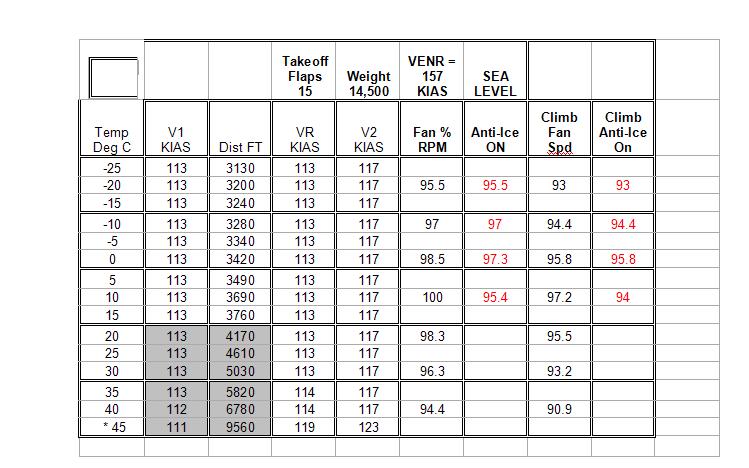
I then get the ATIS transmission, paying particular attention to the runway in use, and the temperature. It's kind of dumb, Cessna makes us consult 2 different manuals to get information on speeds and thrust that we need on each flight, so combined them - I made up a little book last year which shows our various allowable settings, it looks like this (click on it to make it bigger):


This chart shows us at our maximum takeoff weight of 14,500lbs at sea level. I did up charts from sea level all the way up to 7,000' ASL, and in 500 lb increments from 11,500 lbs to 14,500 lbs, for a total of 56 charts. Yeah, it took a long time to do them all, but it really makes it a lot quicker to get the information I need. The newer series of corporate jets will calculate all this information for you, but not the 550 I fly.

Anyway, for example, suppose it was zero degrees outside when we were going to take off from Boston Logan airport, elevation 6'. I just read across the chart and it tells me my V1 is 113 knots, my Vr is 113, my V2 is 117, my Venr is 157, and I am going to need 3,420 feet of runway in no-wind conditions if I want to meet my accelerate-stop requirements. If the temp is between two different charts, then I either interpolate them or just use the chart that has the more conservative set of numbers and requirements. I also have the original Cessna charts on board the aircraft in case the numbers are really tight (going out of Aspen, Colorado on a hot day for example), but the charts I made work in 99.9% of the situations I have encountered so far. Anyhoo, moving right along...

That chart also tells me that I can use 98.5% N1 rpm for my takeoff thrust setting, reducing it to 95.8% in the climb (we set climb thrust at 1,000' AGL after takeoff). If there was visible moisture in the air and we needed to use our engine anti-ice systems, we could only set 97.3% for takeoff and 95.8% for climb as the anti-ice sucks a little power from our engines and makes them run a little hotter.


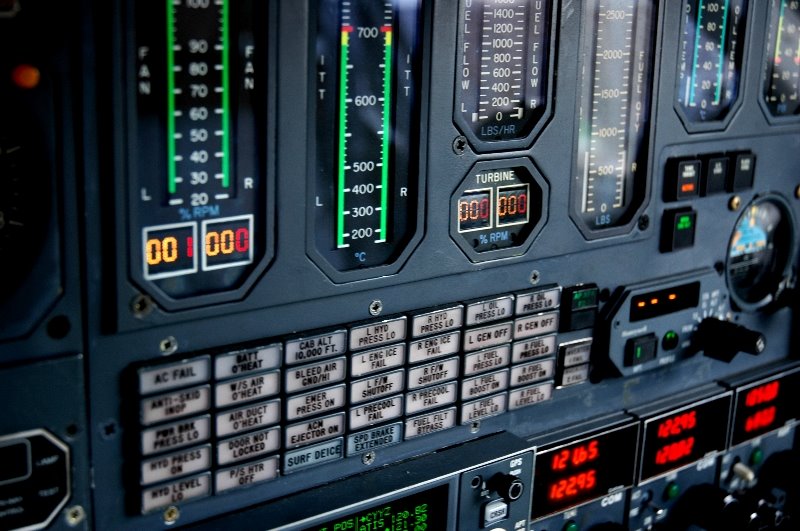
On the left of this photo are the N1 gauges (the ones marked FAN with the digital displays at the bottom), which is our primary indication of engine power. You can see a backup artificial horizon at the far right - this particular airplane has 3 primary artificial horizons and one backup - the boss likes lots of backup systems.


For those of you who don't deal with V speeds, here's the rundown:

V1 is the decision speed we use - if anything major happens before we reach that speed, we can pull the throttles to idle, stomp on the brakes, deploy the speedbrakes, pray, and stop in around 3,420 feet of runway (according to that chart). After that speed, it's safer to continue the takeoff and come back around to land rather than attempt to stop on the runway. It's also the min speed at which we can blow an engine, continue the takeoff and still make the minimum required height above the runway at the end of the runway.

Vr is rotation speed, the speed at which we pull back on the control column and start pulling the nose to 11 degrees nose-up for the takeoff. It's also determined so that we will reach V2 speed by the time the aircraft is 35' above the runway in climbout. Which leads us to...

V2 is the best single-engine angle of climb speed, so if we lose an engine we attempt to maintain V2 which will give us the maximum altitude in the shortest lateral space. Climbing at V2 speed following an engine failure will let us meet our second-segment climb profile of at least 2.4% climb gradient and which is the limiting segment on the 550, but that's too boring for me to go into detail on here. I think of it as our best single-engine climb speed.

Venr is the best enroute single-engine climb speed. After we have climbed high enough that we aren't worried about hitting trees or parked cars off the end of the runway, we accelerate to Venr for the duration of our single-engine climb.

Phew, my brain hurts.

Anyway, I write down the speeds and thrust settings on a little cardboard card, and put the card on the dash of the aircraft. I then set our various airspeed indicator bugs to reflect the proper V-speeds, and then input the allowable engine thrust rpm settings on a little indicator just above the engine rpm gauges.

I then call clearance delivery and ask them for our IFR clearance to wherever we are going. I read it back and then program our GPS with our route, taking care to spell the waypoints correctly lest the plane think we are going from Toronto to Ottawa via some spot in Ecuador. I pull out the airport diagram charts for Toronto and put them in the chart holder in the right seat so my copilot can tell me where the hell we go to get on the proper runway - after a year I'm still not entirely comfortable around Pearson, so I always get the copilot to double-check our position and routing while we are taxiing.

Once the route is entered in on the GPS, we are pretty much good to go. While I have been doing this, the copilot has been setting up the back end of the plane, making sure the magazines and newspapers are on board, and the ice is in the coolers, and the snacks are fresh, etc.

Then we wait for the passengers to show up, load them up and the copilot does a safety briefing while I fire up the engines. The start sequence for the 550 is very simple - press the START button on whatever engine you want (it doesn't matter which one we start first) and wait until around 10% rpm, then move the throttle from the off position to the idle position, then wait until the engine stabilizes at around 49% rpm - It takes maybe 15 seconds from the time we hit the start button to the time the engine is happily idling. We then do the same thing for the other engine. In some turbine aircraft you can easily exceed various temperature and pressure limits while starting the engines, but not this puppy - I have never even come close to a hot start with these engines. If I did, I'd simply pull the throttles back to the "OFF" position and hit another button cleverly marked "Starter disengage". This is a slow, stable airplane and there are few situations where you have to have cat-like reflexes while operating it.

Once we have the engines up and running, we indicate to the ground crew person that we want them to disconnect the ground power unit, and then we put our generators online and the ship starts to run on her own power.

More airplane geekery later, my fingers hurt. Hopefully I can get the plane to take off in less than 10,000 words :)


I'm getting fat. Before I elaborate, here's some long-winded background:

Today I'm preparing for a trip to Teterboro, then Nashville, then Memphis. I'll be returning on Friday, so I'll have a bit of time at each place to check out the sights. This is one of the main reasons I became a pilot, so I generally make the most of it. Who the hell wants to sit in a hotel room in a strange city when they could be out exploring?

Teterboro is in New Jersey, across the harbor from New York city. There is so much to look at and do in New York it's overwhelming. Memphis is an awesome city with a pretty interesting musical history and some great bars downtown. Nashville is known for country music and good food. I expect to gain at least 10 lbs worth of chicken fried steak or steak fried chicken (with biscuits!).

That kind of brings up the main point of this post: With my current job, when we are out on a layover we don't get per diems. For those of you not familiar, per diems are generally a cash payment for meal expenses incurred during trips. If you want to bring your own lunch from home, then you pocket the cash, or if you want to visit McDonalds for supper, then you pocket the difference. A lot of pilots use per diems as a significant source of income - my pals at Air Canada Jazz say that they take home between $800 and $1,000 per month from per diems, which is a lot when they only make $33,000 per year or so.

My old medevac job had per diems of $2 per hour spent on duty, but my present job doesn't have that system. Instead we have a far more insidious way of doing things: They cover all my meal costs. I got our handy dandy computer system to tell me what we spend on meals during trips, and it told me we spend US $143 per crew member per day. Our bosses are particularly generous and allow us to expense beer with supper etc, so alcohol is a fair portion of that amount.

When I got this job one year ago, I was at 190lbs, which is a comfortable weight for me (I'm 6'1" tall). When I did my medical last month the scales pointed at 218lbs. Yup, I gained nearly 30 pounds since I got this job, and I can honestly say it's entirely due to the meal allowance system here. We never eat at fast food places, and we never miss a meal. If we are going to be flying during a meal, we'll either get catering on board, or wait until we land and hit a restaurant on the way to the hotel. Since I got my medical done I have been exercising and watching what I eat a lot more, and have lost 8 pounds, but I have at least another 20 to go.

I think we need to change our system to per diems so I don't die of obesity, 'cause under the current system I order the most expensive thing I can find on the menu, just because I can. To further lower your opinion of me, when I was in Nassau once, I ate dolphin 'cause it was on the menu and it was expensive. Not the fish, the mammal. For the record, it tastes light, like pork, or perhaps a toddler. Yes, I am going to hell.

Monday, August 07, 2006


Click on the pic to make it bigger.

It's a test of reentry vehicles of the LGM-118 Peacekeeper ICBM at Kwajalein atoll. I just got back after a long weekend on the beach and no internet for 3 days. I am itchin' to update the blog, so I'll do something big tomorrow.

Friday, August 04, 2006


This post is about the one and only time I flew into a thunderstorm.

This was a few years back. I was flying a Cessna 441, Conquest II. The 441 is a great turboprop. It'll go to FL350, it'll do just over 300 knots and it can carry a huge load. On this particular occasion, I was single-pilot. This charter leg was returning to Toronto from Teterboro (Teterboro is right by New York city and is the business jet hub for New York), taking a full load of 9 pax. My passengers were returning from the Academy Awards, in which they had received some award for technical achievements. This wasn't the big Oscar ceremony, it was the smaller one that takes place a few days before the main televised one, where they hand out the awards that John Q. Public doesn't care about so much.

Anyway, my pax had a LOT of gear - they had their overnight bags, their tuxedo garment bags and their Oscar goodie bags. The plane was full of stuff, and bags were stacked in every available nook and crevice of the airplane. The pax boarded and it was a snug fit, but everything was within limits. Even back then I didn't mess around with overloaded airplanes - I just couldn't see the advantage to taking off over my allowable aircraft weight under any circumstances.

Weatherwise, there was a strong, fast-moving warm front extending north-south right in between Teterboro and Toronto which I would have to go through on the way back. The cloud conditions were such that there was pretty much solid cloud all the way home, from a thousand feet above ground extending up to maybe 30,000 feet. It would be solid IFR all the way back, but that wasn't a big deal as I had weather radar on board as well as a nifty new item that I hadn't used before - a strikefinder. A stormscope detects electrical discharges in the area, presumably lightning, and lets you know what clouds are the dangerous thunderstormy ones and what clouds are just your normal rain/precip mixture. I hadn't used a strikefinder before, but I was very familiar with the weather radar unit, a decent Bendix one that I had used on many previous flights.

We fired up and took off, and climbed up to 30,000'. For a relatively short trip like this (just over an hour) the controllers prefer to keep the aircraft at 30,000' or less, even though I could have climbed up another 5,000' without problems. It was bumpy and rainy all the way up, but nothing too serious. I set my weather radar to sweep 80 miles ahead of us so it could let me know if there was any significant precipitation that we should avoid. The radar showed nothing, which was fine by me. We levelled off at 30,000' and cruised along. There was a trace of icing, nothing serious, so I inflated the wing boots once in a while to keep it under control. One of the passengers, the guy who was paying for the charter, was sitting in the copilot's seat and I gave him a quick tour of the cockpit. "This is the artificial horizon, this is the airspeed indicator" etc. After about half an hour of solid cloud, I noticed that it was getting a little bit darker. I again checked the weather radar and it showed nothing. I tilted it downward so it would paint the ground, and it reflected the ground, so I was happy that it was working correctly. The turbulence became a little worse, and we started seeing heavier rain hit the front cockpit windows. I put on the passenger seatbelt light and we continued. I noticed that the strikefinder was showing a lot of little + signs around the airplane, but I figured that it hadn't been calibrated properly as the radar was still showing nothing significant in front of us.

The clouds around us went black. The rain became very, very heavy and we started to experience some moderate turbulence. I turned on the ignitors, hopefully to prevent engine flameouts while they were trying to breath water instead of air, and disconnected the autopilot. I heard a few moans from the back, and the passenger seated next to me said "My wife is getting sick, where are the airsickenss bags". Well, the airsickness bags were underneath all of the passengers' goodie bags from the Oscars, and underneath their garment bags. Clever me, I hadn't even thought of that before we departed for Toronto.

We then hit a brick wall. I hit my head on the ceiling even though I was strapped in firmly. The airplane shook violently, so much so that the instrument panel became a blur. I don't know if you have ever been in a car accident, or perhaps skidded out of control on the highway, but if you have, have you experienced the sensation of time slowing down to a crawl? Well that's what it was like for me; things started to move in slow-motion. I could see that we were climbing at 6,000' per minute. I called Air Traffic Control and said "We are unable to maintain altitude, do you see anything in radar in front of us". "Yes, you are penetrating a level 4 area of weather, it's about 15 miles wide and 60 miles long. You are cleared to deviate as required, there are no other aircraft in your area". Of course there weren't other aircraft, nobody else was dumb enough to be around a thunderstorm. I could hear screams in the back, and from the corner of my eye I could see my 'copilot' passenger sitting rigid in his seat, his hands holding the side of the cabin for grip.

I fought to keep the wings level and a general nose-up attitude. I pulled the power back to slow to 180 knots, which was our manoeuvering speed - in theory a huge gust of wind should stall the wing and unload it rather than ripping it off. We started to descend and I watched the blurry altimeter unwind from 33,000' to maybe 28,000' in a blink of an eye. The rain became more solid, and I think some of it was hail. I knew that it was below zero outside, so we were most likely icing up on the wings. I was scared to press my face against the cockpit window in case another huge jolt mashed my face into it, but I knew the icing was out there, adding to our general misery. I set the boots to auto-inflate, hoping that it would keep up with the ice accumulation. The noise was incredible, it was like being inside a drum at a military procession, with the rat-a-tat noise of the precip striking the aircraft so quickly I couldn't count the beats. More screams from the back as we were lit up by lightning that was so close it felt like it was inside the cabin. And my weather radar showed nothing.

It's funny what goes through your brain when you can hear the angels singing. Because everything was in slow-motion for me, I had a relatively long time to think about the circumstances that had brought us there, and what the possible consequences to my actions were. It wasn't particularly comforting.

We were now at around 25,000' and still in the crap. That's when the hail came. We were pounded by golf balls fired from a cannon at 200 miles per hour and the people in the back started to completely freak out. I smelled vomit. I was using all my strength to keep the wings level as we were tossed violently in every direction, and the little man in my head started to ask me what the strength of the control cables were and if they might in fact snap. I told him to shut up and continued to fight the thunderstorm. I am not a religious man, but I decided to cover my bases and send a general prayer that our windshield would hold against the hail.

Then it was over. We exited the far side of the cel and it was wide open, with just a few wispy clouds beneath us and the sun shining in front of us. I reconnected the autopilot and sat for a few seconds, just breathing. I could hear crying from behind me, and the smell of vomit was strong enough that I knew it wasn't my imagination. I told ATC we were through the weather and let them know we were okay. The person on the other end didn't seem particularly concerned, and in a way that made me feel a little better. I might have nearly killed all of us, sure, but at least I hadn't caused a big ruckus on his end.

The windshield had held, thank Jebus. I looked out the side window and saw we had a nice thick coat of clear ice, so I blew the boots one more time and watched it mostly fall off. We started our descent into Toronto, and I finally got the courage to turn around and ask if anyone was injured. Two of the women were still crying, but nobody had been hurt. That being said, it looked like every single passenger had vomited. We landed in Toronto and shut down. My pax shakily deplaned without a word and I told them I was expecting them to call my boss, and that I would be calling him also. Most of them had stains all over their clothes. I called over a line guy who wrinkled his nose as he loaded up the barf-encrusted luggage onto a cart, then pushed it into the FBO for the pax to recover at their leisure. "What the hell happened?" "I guess they had some bad food at the award ceremony." I wasn't in the mood to discuss it.

Fortunately Canada Customs hadn't shown up and we were cleared in over the phone, so they didn't have to wait to get searched by Customs and I didn't have to explain to customs why my pax were so very bedraggled. They left and I went back to the aircraft.

I did a quick walkaround of the airplane. None of the metal skin had wrinkled as far as I could tell, but 2 of the antennas on the aircraft belly had been ripped off, as well as a few static wicks on the wings. The right wing deice boot was in shreds, with most of it hanging from the leading edge of the wing, but I hadn't noticed that until after we landed. The inside of the airplane smelled like wine and digestive fluid, and there was barf EVERYWHERE.

I called the boss and told him I flew through a thunderstorm, and he could expect some angry calls from the passengers. I told him about the strikefinder and said perhaps I should do some formal training on it, and then told him that the weather radar painted the ground, but it hadn't painted anything on the flight.

"Oh yeah, it's been broken for a few days. Didn't I tell you that? Sorry."

Yeah, no problem. I called maintenance and told them to get their haz-mat suits on and start working on restoring the airplane to flyable condition, then drove home, drank 4 beers in a row and went to bed. I was exhausted. In my dream, I was fishing for sharks. I nearly caught one.

Thursday, August 03, 2006


I'm in Nassau, Bahamas right now. We arrived here yesterday morning after a 3 1/2 hour flight (the 550 is not a particularly fast jet), and we are heading back home this afternoon. We come here twice a month on average, and normally stay for 4 days each time, but this trip is a short one, a mere overnighter. I checked my passport and since last November I have been here 14 times. It's a decent run, but we have had to deal with hurricanes and more 'active' weather than we normally deal with on our regular runs to New York or Montreal or Winnipeg etc.

Nassau is a very interesting place - it's not a third-world country, but the poor here are very, very poor. I guess it's more of a second-world country, like Mexico. The locals here are very friendly and charming and polite, and it feels genuine when they call me "darling" or "dear", rather than the forced manners I get from some places I have visited closer to home. The local food is amazingly good, with tuna and mahi mahi being popular fish dishes, along with conch salad and sugar cane shrimp, plantains and grits for carbs, and of course hot sauce that goes on everything. Wash that down with a few Kaliks (the local beer which is like a religion here) and you are guaranteed a good feed.

The weather is incredibly hot, like 35 degrees C with 80% humidity so I am constantly sweating. I like sweating though, it makes me feel kinda sultry. There are better ways to work up a sweat, but that too is a topic for another time.

Normally we stay at the British Colonial Hilton here, but it was all booked up so we are at the Radisson which is a lot larger, but also considerably more tacky. Obese, sunburned young men are here in droves, driking generic rum and showing off the tanlines they got when they fell asleep in the sun wearing their wifebeaters. A few young women cavort in bikinis, all big hair and gold jewelery, fully aware of the hungry eyes watching them as they play beach volleyball. I think that's how life must be when you are a gopher in rattlesnake country.

There is a casino in the hotel complex and it's also full of tourists. These ones are older, they spend their time feeding the slot machines and chain-smoking Cuban cigars. The huge fans that are installed in the casino can't keep up with the smoke, and the air is fetid and nearly grey. Why on earth anyone would come to a tropical paradise like this and spend their time in the casino is beyond me - the water is clear here, and the beaches are beautiful.

A huge part of the local economy is tourism, and everything here is fairly expensive with the exception of alcohol. You can get a litre of vodka for $6 here, or 375ml bottle (a 'mickey' in local parlance) for $2. The local rum is very potent, so I am only good for a couple of pina coladas before it's nap time.

I'm on dodgy stolen wireless at the moment, so I'm going to take my leave shortly, but the little man in my head is telling me to write a big long post about Bahamas when I get back tonight.

The weather is very unsettled around Toronto right now. A cold front is moving through after a few days of scorching heat, bringing particularly violent storms through the area this afternoon. We should be home around 7pm, hopefully avoiding the worst of it. One real pain in the ass is that Buffalo makes us descend pretty early going into Toronto, which might put us directly in the thick of things going into Toronto. Or everything could have moved out of the way by the time we get in, it's too far in advance to know exactly what is happening. I hate thunderstorms - I flew through one, once, and that was enough for me. That's another story entirely, and I will prolly end up writing about that in a future post. Our pax will be here in an hour or so, so it's time to fire up the gpu and get the plane ready for the 3 1/2 hour trip back. See you in the skies!

Tuesday, August 01, 2006


I had my 35th birthday a couple of days ago - I guess the people in the balloon got the info wrong :)

Damn, I'm halfway to 40 already and it seems like I have only just begun to make my impact in the world, let alone take it over. Seriously, I'm pretty happy though - my previous self-assessments at age 20 and 30 were somewhat more uncertain, but I actually feel like I'm right where I want to be in life. I am healthy, I have a good job, I love and I am loved. I still have a few major things I want to experience, like owning a house and owning a child, but I don't feel like time is running out or anything and overall I'm deleriously happy. I don't know what I did in a past life to deserve this, but I sure am grateful.
Here are a few pics my roommate snapped of the Dash-8 Q400, as seen in Toronto. It definitely has ramp appeal. The official site is HERE. The big deal about this airplane is that it's quiet (they use active noise cancelling technology in the cabin), it's big (over a hundred feet long) and it's fast (it'll do over 400 mph).

I like the fact that the engines together provide over 10,000hp. My little jet only provides 5,000 lbs of thrust. I have only flown 2 turboprops, the MU-2 and the C-441 Conquest II. Both of them are around 1/6th the size of the Q400. I would love to fly a heavy one such as this.

A good friend of mine is interviewing for a Dash-8 Q400 job in a couple of days; keep your fingers crossed for her, I think it would be a great gig!


General characteristics

* Capacity: 68-78 passengers, depending on configuration
* Length: 107 ft 9 in (32.84 m)
* Wingspan: 93 ft 3 in (32.84 m)
* Height: 27 ft 5 in (8.34 m)
* Useful load: 26,612 lb (12,070 kg)
* Max takeoff weight: 64,500 lb (29,257 kg)
* Powerplant: 2× Pratt & Whitney PW150A turboprops, 5,071 shp each

Performance

* Cruise speed: 360 knots (414 mph, 667 km/h)
* Range: 1,362 nm (1,567 miles, 2,522 km)
* Service ceiling: 25,000 ft (7,620 m)