Tuesday, July 13, 2010

Checkride Post, Part II. Scroll down 2 posts for Part I.

I wanted to make a good impression on the 2 Transport Inspectors who would be accompanying me on the ride, so I printed out copies of the candidate's licence info, the company SOP's, the company flight profiles, the company training program, the company Ops Manual, and all the approach charts we would be using, both at Toronto Pearson and Hamilton, the nearby airport we'd be conducting most of the checkride at.

I put the twelve pounds of paper into a binder, and made a nice pretty cover on it, hopeful that a slick presentation might be an acceptable substitute for (lack of) professionalism and skill on my part :)

I was all prepared for the ride, and the weather forecast was actually threatening to cooperate, so all I had to do was wait until the next day, then drive to the airport and get it over with.

I slept really poorly the night before the ride, which surprised me, considering it was the candidate who really was under the gun - I found myself doing flying checklists and emergency drills in my sleep. When I'm the subject of a check-ride I usually have a lousy sleep the night before and end up doing checklists in my head all night, but at least I have the drills for my own airplane memorized - in this case, I had never flown up front before, and I wasn't overly familiar with the aircraft checklists, so my brain was simply inventing things, like "sleep on your side, then rotate pillow counterclockwise 1/2 turn, then clockwise 2 turns" etc. Finally 7am came, and I got ready, then drove to the airport. The weather turned out to be great (stupidly hot, but clear skies), so that was one less thing to worry about.

The candidate was already at the airport, checking weather, double-checking his weight and balance for the aircraft, and generally fretting. I did my best to console him.

"Dude, I totally understand where you are coming from. Checkrides $%#@ing suck - I have to do them too, and I can empathize. I will give you a fair evaluation, and I have no intent to make this more traumatizing than need be."

"Thanks Sully, but you gotta remember there will be 2 guys from Transport Canada looking at me the whole time, and I don't know what their mindset is."

"Oh yeah. Now I'm stressed, thanks for that."

He smiled a little, so that was nice.

After a little while, the copilot showed up, and so did the 2 Transport Guys. I recognized one of them from a previous training course - he was a good guy during the course, so that was good to see. The other guy was a fresh inspector who was attending this session to get up to speed on how monitored checkrides worked, and I introduced myself.

"Hi, I'm Sully. Nice to meet you, let's see if we can't survive this process."
He smiled.
"Hi Sully, I'm Inspector #2. I used to be in Transport Canada Enforcement, and I don't recognize your name so I guess that's a good thing. Oh, it says that the company you work for has just been assigned to me - I'm your new Principal Inspector, so I guess I'll be seeing you again when I audit you next month."
"Audit? Next month? Ack!"

So the new inspector was a guy I'd be dealing with soon when my own operation was on the line. I crossed my fingers and silently pleaded with my various deities to not let me have a meltdown during the ride, which would not bode well for future interactions with this fellow. At least I was wearing pants, so I was hoping I made a decent first impression.

I handed the inspectors their shiny binders full of relevant information, and the 5 of us (2 Inspectors, the candidate Captain and his First Officer) sat down to chat for a bit.

Here's the cheat sheet I made up for this briefing, so that I wouldn't forget to cover all the important (ie required) points:

---------------------------------------------------------

Company Check Pilot Briefing Guide


• Introductions

• How are you doing? Did you sleep okay? Are you feeling well?

• We are here today to renew your PPC/IFR. Once we are done the ground part, the flight should take about an hour and a half, depending on the mood of ATC. I imagine you are a bit nervous, but don’t be, this is going to be a walk in the park. The standards are no tougher than the ones you have already shown you can meet. The training you have been doing for the past few days is likely a lot more difficult than this ride, and it will probably be anticlimactic for you.

• In training you had multiple failures, one after the other. During the ride we will NOT have multiple unrelated failures, and we can go at a much slower pace. I will tell you if/when simulated equipment failures will arise. If some equipment stops working in real life, we will assess the situation and will either continue on with the ride or end the ride and return to a safe airport.

• During the ride, avoid the temptation to rush. If you find yourself feeling rushed during any part of the ride, ask for vectors or a hold to give you as much time as you need before moving on to the next phase.


• From time to time you may notice that I’m writing things down during the ride. My writing things down does NOT mean that you have screwed anything up; I could be writing good things as well as things to bring up during debriefing, or just simply writing down questions about the aircraft – I have only flown in a PC-12 once, so I might have some additional questions at the end of the flight just to satisfy my curiosity.

• During the ride you may think you have messed something up. As long as the ride is still going, the ride is still going, so try to put any perceived errors out of your mind and move on to the next phase.


• When we get to the plane assume it’s the first flight of the day, which means a black cockpit. Also, assume the weather is at IFR minimums, and you can expect the weather to be at or below minimums for the approaches being conducted. When you get to the DH or the MAP, I’ll tell you if you see the runway. If you see the runway, then land! Otherwise, conduct a missed approach.

• Now onto the ride sequences: As you are no doubt familiar, we have to demonstrate some required items, which we will quickly go over. We need to see a normal takeoff, a rejected takeoff, a hold, 2 approaches (one precision and one non-precision), at least 2 engine failures, and at least 2 landings. With your Ops Spec we will also need to see (circling) and a GPS approach, along with demonstrated single-pilot authority as well as multi-crew Captain authority. We will also have a few abnormal situations come up and will expect you to deal with them just like how you would in real life.


• During the ride, you will be evaluated in accordance with the Pilot Proficiency Check and Aircraft Type Rating Flight Test Guide (Aeroplane) TP 14727. Are you familiar with the standards? (heading, altitude tolerances etc)(If candidate is not, then provide candidate a copy of the flight test guide and allow candidate to become familiar with the standards)

• Fill out paperwork, consulting laminated “PRIOR TO CONDUCTING A FLIGHT TEST” card

• Do you have any questions so far?

• We will try to keep the ride as realistic as possible. The PF is generally expected to initiate the response to an emergency, but there are 2 crew on this ride, so help each other out as you would on a normal flight in real life. We want to see you work as a team, and operate according to ATC clearances, your company SOP’s, the AFM, the CARs, your emergency checklists and any and all other applicable publications. With 2 crew rides, this means that both crew’s licenses and qualifications are being evaluated, and a serious mistake on a ride could possibly affect the licences and qualifications of both crewmembers. You can use the automation in the airplane just as you would in real life, so don’t hesitate to use the autopilot when applicable to make your life easier.

• During the ride I may give you some instructions and ask you to relay them to ATC. If one of my instructions conflicts with a real ATC clearance, please follow the real ATC clearance but let me know. I will not attempt to trick you, and I will not intentionally give an illegal or bad instruction. That being said, you are responsible for any instructions and clearances that you choose to accept. Any situation caused by an incorrect action or response will not be corrected by me unless it affects the safety of flight.

• If you have any questions about anything, feel free to ask. During the ride, if you have any questions about a clearance, a ride sequence, or want to clarify anything I have said that might be confusing, please ask.

• I know it’s easy to say, but do your best to relax, and take your time.

• Any final questions before we head into the plane?


POST-FLIGHT DEBRIEFING


• This was a pass / fail, and I have a few items I’d like to go over before we are done here.
• How do you think you did (don’t let candidate only focus on errors, also highlight positive things)
• I think overall you did very well, especially (highlight above-average performance)
• Identify major / minor errors, attempt to advise not criticize
• Do you have any questions before I sign your licence?

If Pass: - Endorse Licence or issue temp licence privileges
- Complete Application for Endorsement

If Fail: - advise reasons for fail
- advise regarding re-test
- advise right to appeal to TATC
- suspend IFR rating

---------------------------------------------------

You may notice that I never mention the word "failure" during my little speech. That's on purpose. I figure it's a scary enough experience for the candidate and it would just add to the stress level - everyone who has done a checkride is acutely aware that it's possible to fail one, so why emphasize that?

After I gave my speech, we talked about the airplane for a while, with me asking various technical questions (detailed a little in my previous checkride post) and the Captain answering them. He got them all right, and on the ones he didn't have memorized, he knew exactly where to look for the answers (ie, the aircraft flight manual, or the CAP Gen section, or his company Operations manual etc).

Having satisfied our requirement to conduct a ground briefing, we then headed to the airplane. The Inspectors sat behind me and wired themselves into the audio system so they could hear the crew and Air Traffic Control. They had copies of my planned ride script, so they knew in advance what emergencies I was going to introduce on the ride. I wedged myself in between the Captain and Copilot, plugged myself into the intercom and watched as they fired up and taxiied out toward an active runway at Toronto Pearson.

I watched as they followed their checklist, and as the Captain carefully taxiied down the exact middle of the taxiways. The crew had flown together before, and they were clearly comfortable with each other, so that made the checklists flow quickly and easily.

I de-wedged myself from the cockpit and took a passenger seat for the takeoff, then went back up front to observe. We flew toward Hamilton and found a nice clear patch of sky to get our steep turns out of the way. The candidate did just fine, so we got a clearance to hold at a navigation beacon right by Hamilton. Again, the candidate did just fine. After the hold, we set up for a GPS approach to a runway, circling for a different runway. No problems there at all, the candidate circled and set himself up for a nice landing. I had other plans though - when we were 50' in the air about to land, I told him that a moose had strayed onto the runway, so the candidate did a low-energy goaround, (a mandatory requirement since an Air Canada crash in Fredericton a few years ago). He was smooth, calm and collected, and we climbed skyward. I then asked him to do a visual circuit for the original runway, and when we were downwind for landing, I asked him to simulate an engine failure. This is the part I was most curious about, and it turns out the PC-12 can glide a pretty great distance with a failed engine, so that was cool. On a single-engine ride it's not a mandatory requirement to be able to glide to a runway after an engine failure - the candidate just needs to be able to demonstrate the proper emergency drills and maintain control of the aircraft to touchdown - but in this case we had more than enough altitude to set up for a gliding arrival onto the runway in Hamilton. That was all the multi-crew stuff done, so I told him that the First Officer had eaten some bad salmon for lunch, and the Captain was on his own for the final leg back from Hamilton to Toronto. No sweat, he did all the checklists by himself and we blasted off from Hamilton back home.

This is the part that got a little interesting.

We were about 10 minutes from Toronto when ATC came on the radio and said "Trainer 1, Pearson is closed due to an aircraft emergency. Say your intentions." I pointed at the f/o and did the finger across the throat sign, indicating that he was to remain silent and let the Captain figure all this out - this sort of thing could conceivably happen when the Captain was flying single-pilot and it would provide me an unexpected but good source of additional information to help evaluate the Captain in the performance of his duties.

The Captain did all the right stuff - he knew that the weather was good so we could land at a few different airports if need be, but he still had a mission to accomplish (get us back to Pearson safe and sound), so he didn't want to give up just yet. He confirmed that we still had a couple of hours of gas in the tanks (a PC-12 with full tanks can go for about 7 bladderbusting hours if need be), so he asked for ATC to let us hold while they dealt with the aircraft mayday at Toronto. They gave him a hold clearance, and we headed toward the navigation fix, which happened to be out over Lake Ontario. He also climbed up so that we could glide to the shore in the unlikely event the engine failed during the hold, and that told me he had good situational awareness - he was able to think outside the box a little, and not just follow checklists, which is a sign of a good Captain. We did a few laps around the lake before ATC told us that the emergency had been dealt with. Once that was all good, we set up for an uneventful single-pilot ILS back into Toronto.

The Captain landed, taxiied back to our base and shut down, taking care not to knock the wingtip against the hangar door (people have actually passed a checkride only to fail at the very last minute by screwing up the aircraft parking and smoking a solid object with a wing). I told him he had passed the ride, and we all went inside to debrief.

The debriefing was uneventful - the Captain's performance was damn near flawless, so I really didn't have much to say. The Transport guys were also satisfied that he knew what he was doing, and that I knew what I was doing when I said that in my opinion that he knew what he was doing. I did the final bit of paperwork, the Captain got his license signed off, we shook hands, and that was that.

My new Principal Inspector seemed happy, so hopefully he at least won't be predisposed to put me in federal prison when my company audit comes up at the end of August. Hopefully.

Finally, here's a copy of the evaluation that I got from the Transport Canada Inspector who watched me. The marking scale is interesting - a mark of 3 indicated that I met the standard, while a mark of 4 indicates that I exceeded the standard in that particular field. I was happy with what I got - the only comment from TC was that I could have asked more questions during the ground briefing, so under "Scope of Flight Check" I got a bunch of 3's with extra bonus points for going above and beyond.


You'll see that the notes section says that the checkride was for the addition of SMEL, which means that now I can conduct PPC/IFR checkrides on just about any non-jet aircraft, and also conduct checkrides in the actual airplane rather than just in the simulator. This expands my authority, and will hopefully allow me to conduct a few more checkrides between now and this time next year, when my ACP renewal comes up again. I don't do it for the money, but I actually really enjoy the experience, and it's an interesting way to meet new people and see how other pilots fly.

Damn this was a long-winded post, but I hope I was able to peel the curtain back a little bit and give you a slightly better understanding of what goes on during a checkride from the perspective of the person doing the checking. Safe flights!

ps The emergency at Pearson turned out to be an aircraft that had an unsafe landing gear indication, but was eventually able to fix the problem and land uneventfully. We were only delayed about 15 minutes, so no huge deal.

Sunday, July 11, 2010


I'll finish my previous post tomorrow, I got busy this weekend with sundry stuff. We are in New Jersey tonight, and I saw a famous person as we were driving away from the FBO! A famous person from New Jersey, actually. A famous person in track pants...

Wednesday, July 07, 2010

I had an interesting flight yesterday, but I wasn't sitting in the front. I was in fact squatting in the aisle for most of it. Nope, this wasn't in the simulator either.

Long story long: I'm an ACP (Approved Check Pilot) for the Citation 550, which means I can do checkrides on other pilots in that particular type of aircraft. I wanted to widen my scope a little bit, so I asked Transport Canada if I could get authority to do checkrides on all single-and-multiengine non-high-performance aircraft, which essentially means all non-jet aircraft. They responded with a letter saying that they would like to see me conduct a checkride on a small aircraft first before making up their minds. The letter pointed out that I have only conducted checkrides in the simulator before, and conducting one in an actual aircraft can be a quite different experience (I found out yesterday how very true that is, but I'm getting ahead of myself). Fair enough, that's entirely within their rights. I started looking about for someone who might need a checkride, and I ended up chatting with a friend I have known for a few years, a guy I flew with who later left the Citation 550 and went into management at a different charter company that operates turboprop (jet engines that spin propellors) aircraft. He mentioned that one of his pilots needed a renewal checkride, and the die was cast. I told him that a Transport Canada inspector would be riding along with us, watching me watch the candidate, and to his eternal credit he agreed to that scenario. Perhaps you're thinking "Sure he agreed, it wasn't him that was going to be flying", but that's only partially true. You see, the particular turboprop aircraft we flew on is certified for flight with one or two pilots, depending on the scenario, and my friend would be acting as the copilot on the checkride. The funny thing about being a copilot on a ride is that you don't necessarily get anything renewed at the end of the ordeal, but if you screw up you can have your license suspended. Now that I think about it, I guess that's not actually very funny, but whatever - it's how things are done in Canada.

Anyhoo, I have only flown in this particular turboprop as a passenger before, so I got my grubby paws on some aircraft manuals and did some studying so I'd at least have some decent questions to ask the candidate during the ground briefing. I prefer to ask questions that have an operational slant to them - instead of asking stuff like "draw me a diagram of the fuel pump and explain how it works", I prefer to ask things like "If you land at an airport and they accidentally fuel you up with avgas (for piston-powered aircraft) instead of jet fuel, can you fly the airplane home?" or "You are stuck at an airport overnight in -40 temperatures. The only hangar that's available is 50 feet wide by 50 feet deep by 18 feet high. Will the plane fit?" or "On your walkaround you notice that one of your two aircraft batteries is dead, but the other one is fine. Can you still go flying?" You get the idea. So I cracked open a whole pile of reading material, including their company Ops Manual and SOPs (Standard Operating Procedures), which provide blueprints about how they operate the airplane and the specific duties and roles of the Captain and First Officer during the flight. For example, the SOP's will list the verbal callouts that each pilot is expected to make during the takeoff roll, like this:

Captain: Full power, engine gauges are green, airspeed is alive
First Officer: 70 knots
Captain: Crosscheck
First Officer: 84 knots, rotate
First Officer: Positive Rate
Captain: Gear up
First Officer: through 400 feet
Captain: Flaps up

etc

That way I'd know what to listen for during the flight, and I'd have a better idea of what was going on. Every company has a slightly different way of operating, and differences in SOP's can be significant even if they are operating exactly the same type of aircraft - when I fly a Citation 550 for a friendly competitor I make different verbal calls and perform different actions than when I fly our Citation 550 - different strokes for different folks I guess.

Now getting back to the checkride - as it was going to be in the actual airplane, we would be departing Toronto Pearson and flying to a nearby airport to conduct our training exercises - Pearson is waaaay too busy for that sort of thing. When I do checkrides I like to make up a script that details the exercises we will be covering, along with the general order. In the simulator you can be totally specific about what's gonna happen, and I detailed a simulator script in a previous post. However in the real airplane, sometimes things happen - other aircraft are flying around the airport and you might not necessarily get the exact approach you were hoping for, or the exact runway, or the exact sequence of events you had planned out, so you have to be flexible and if you get a curveball, you might need to plan something else that covers the required items on the ride but in a different way.

On an IFR PPC checkride there are a number of different requirements, including:

- at least 2 takeoffs and landings
- a non-precision approach, and a precision approach
- a hold
- steep turns
- a rejected landing / missed approach
- at least 2 engine failures
- other emergencies as required (that part is fun because you get to decide what simulated emergencies the candidate has to deal with)
- a landing with at least 50% of the available engines failed (you can simulate the engine failures by pulling the power back on the affected engines, we never actually shut them off in the actual airplane)
- other requirements as dictated by the Company Operations Specifications

In this case, the company that operated the turboprop had a couple of addons - they did GPS approaches, they did circling approaches, and they wanted the pilot certified as a Captain in a multi-crew environment and as a single-pilot Captain.

It was time to earn my outrageous salary. I put on my thinking cap and made up a script that would cover the required items. It took me a few beers and some minor cursing but I managed to make it work in a fairly efficient way, at least on paper.

The script for the ground briefing looked something like this:

1. Explain procedures for Engine Failure in Flight, climbing through 1,000'
2. Explain procedures for Crew Incapacitation
3. Explain procedures for Engine Fire during takeoff roll
4. Discuss realistic scenario (like the questions I asked about the hangar width and aircraft misfuelling etc) and answer 5 questions relating to it.

The script for the flight looked something like this:

1. Engine start with simulated malfunction (Hung Start)
2. Area Departure, track to nearby airport
3. Steep turns
4. Hold at a nearby airport beacon
5. Engine Chip light illumination
6. GPS approach for a runway, circling for a different runway
7. Rejected Landing / Missed Approach
8. Visual circuit back to original runway with engine failure on downwind leg
9. Land
10. Single-pilot flight back to Toronto with ILS approach runway 23
11. Land, kiss the ground and endorse the candidate's license


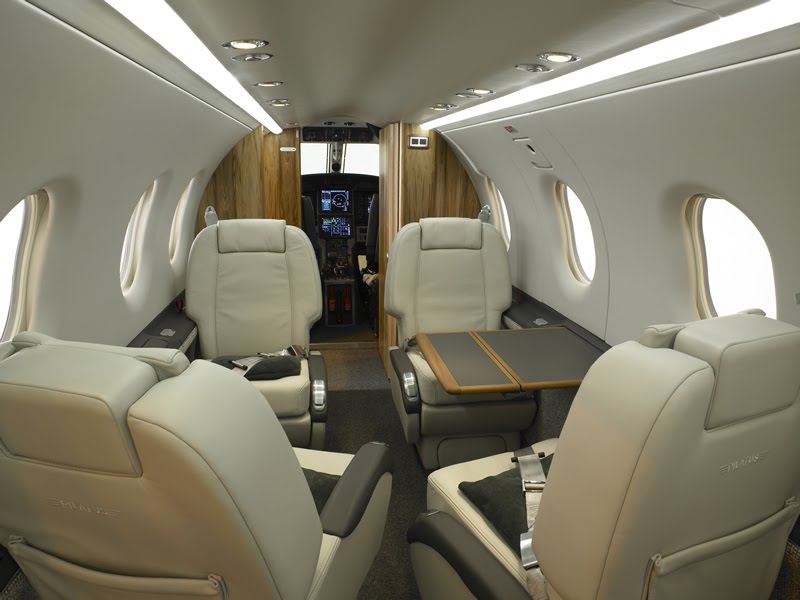
Oh, here's a pic of a typical interior that this type of airplane might have. Pretty nice, eh. This turboprop is not small.


Now here's a pic of a what this type of aircraft looks like:


You may notice a couple of things. First, whomever painted this particular airplane (not the one we flew) probably needs a seeing-eye dog. Second, it has but a single engine. I haven't flown in a single-engine airplane for years, and as part of our checkride, I was going to ask the pilot to simulate an engine failure. Let's hope this puppy can glide better than a brick...

Oh, one last thing before I continue this post tomorrow...Transport called a few days ago and said that the TC Inspector who was assigned to monitor me was also going to bring a junior inspector along to show him how to monitor people conducting checkrides. That means there would be a guy watching the guy watching me watch the candidates. No pressure.

More tomorrow :)

Saturday, July 03, 2010


If your computer has the horsepower, the vid is most impressive if you click on the video, then go full-screen, then change the 360p icon to hi-def 720p.

It was a nice day a few days ago, and I managed to wedge the hi-def camera into the windshield to capture a visual / ILS approach onto runway 23 at Toronto Pearson. I talked all the way through the approach but the noise of the wind on the windshield completely overwhelmed the audio, so I added a music track instead. Hopefully the copyright police won't sue me into oblivion, I think it adds a little bit of fun to the otherwise fairly routine video. The band is Underworld btw. The video is 10 minutes long, and I won't be offended if you decide to skip it, I just like the combo of dreamy music with an unobstructed view out the front :)

The wind was a direct crosswind at 20 knots, but I lucked out on the landing, so overall it was a good day :)

We are in Quebec City at the moment and I have taken a bunch of vids of that too, which I'll post later.

Have a most excellent Canada Day / Independence Day / Summer day weekend!

Tuesday, June 22, 2010


Lots of different layers of cloud and some morning valley-fog. Such a beautiful day today!


We got up crazy early this morning, heading east. The sky was beautiful, and because the longest day of the year was yesterday, the sun came up and kissed the plane about halfway through the flight. It was really neat to see the different layers of cloud, so I took a video. It's mostly boring, but skip forward about 1 minute to see an unexpected surprise - an Embraer commercial airliner 2,000' below us, heading in the same direction. It was a whole lot faster than us, and it was also right in the cloud layer, so it looks pretty cool, like a shark cruising just below the surface of the ocean.


The morning fog was lining some of the valleys along our way, it also looks pretty cool.


The skyline of New York off in the distance as we start our approach into Teterboro.

I took a video the ILS for runway 06 into KTEB, Teterboro New Jersey. Teterboro is where all the corporate jets go to get their pax into downtown New York.

Monday, June 07, 2010


We have been in Miami for the past couple of days, and today we went to Dallas. On the way, we flew over the oil rig. You know the one. I took pics, but the windshield glare screwed them up - maybe that's for the best, you probably wouldn't sleep too soundly tonight if you saw what we saw today. The oil slick is huge, and it's everywhere. There are clouds all around the rig, but they aren't real clouds, it's smoke. The rig itself is on fire, presumably burning some of the gas that's being funneled to the top. The scale of the oil slick is terrifying to see from the air - from 36,000' we can theoretically see 233 miles until the curvature of the earth cuts off our view, and from 36,000' I could see a ribbon of oil all the way to the horizon. And that's only the stuff we can see - I have read that most of the oil is still underwater, being taken by various currents all around the coast. I saw a computer simulation yesterday that says the oil will be up the east coast of the US and Canada by the fall.

I don't have anything funny to say about this - not even gallows humor. It's just too awful.

Friday, May 28, 2010

Thunderstorm season, hooray!


Pepper and I went west on a charter flight a few days ago (Kitsch was still jet-lagged from doing an LA - Toronto redeye the night before, so Pepper pinch-hitted), taking some people to do some business in the midwestern US. For those of you who aren't familiar, summer in the great plains of the United States = thunderstorms.

I took a few vids to demonstrate some of them, let's have a quick boo!


We landed, and hung out for the day at a local Marriott - I collect hotel points and currently I'm concentrating on them - I have enough to last Lisa and I through our entire next vacation, even if we pick a classy hotel. Hotel / Gas card points are a perk of corporate travel that I really enjoy.


It was a 14-hour day, so we made sure we both had naps in the afternoon, so that we'd be fully alert for the return ride. A cold front was passing through, and the heat of the day was building some truly spectacular weather monsters.

Now I wasn't able to video this next part, mostly because Pepper and I were busy little beavers at the time. At Rogers, thunderstorms were building to the point that some of them in the distance were green, like dull emeralds. You know, booming emeralds with lightning. Most of us are used to seeing thunderstorms with black clouds, but green ones are more rare, and they usually indicate something far more apocalyptic, like hail and/or tornadoes, or perhaps clouds of winged monkeys come to take us to Oz. Either way, they were building all around the airport and it became clear that we had a limited amount of time to depart before they cut off all routes in and out of our destination. Now visualize this with me: Our home in Toronto was east of the airport, but the storms were such that 20 minutes before the pax showed up, I had amended our flight plan to head straight west, then north, then back east in order to go around one line, then head north, then mostly east to go around another line, then head south, then east to go around a third line.

Our pax showed up, we loaded up, and in those few minutes, the storms north and south of us had linked up to the west, creating an unbroken line of doom. There was a thin sliver east of us, and our on-board satellite weather system (may it live forever!) showed that some of the scary stuff had dissipated enough for us to be able to climb over it if we kept our groundspeed low and our rate of climb high.

We had already picked up our clearance to head west, but that wasn't going to happen so we had to negotiate with ground control for a new clearance that would keep us out of harm's way. It took a few minutes to get, presumably because the area air traffic controllers were very busy dealing with aircraft that were diverting all over the place in an effort to avoid the storms and keep their wings on, but we eventually got clearance to head straight east in an attempt to climb over the first line of thunderstorms.

Fortunately for us, the plane was relatively light and even in the heat of the day (it was about +30c, which is 86 in American heat units) she was capable of giving us a decent rate of climb if I reefed the nose back to 15 degrees nose-up - our climbout airspeed dropped by 40 knots, but that wasn't as important as getting up and over the smaller thunderstorms that were close-by the airport.

One of the fun things about lines of convective weather associated with frontal systems is that the thunderstorms are usually hidden by other clouds, so on the climb-out we are usually flying through clouds and can't see anything outside. Our weather radar shows us the bad stuff that's mixed in with the ordinary clouds, but I'm not gonna lie and say it's not disconcerting as hell for those few minutes that you are in solid cloud and it starts to get a little black outside, and rain on the starts to beat against the windshield and you wonder whether or not you made the right call, or whether you should be immediately turning 180 degrees to one side or another. We have lots of gadgets to assist us, but there is a reptilian part of our brains that softly whispers scary things for those few moments, and we really have to rely on our training and our experience and our technology to overcome that soft, nasty voice.

Anyway, I'm sitting here typing these words, so you can deduce that it worked out fine - we kept our eyes glued to our on-board weather radar as well as the satellite weather system, as well as looking outside and turning well away from any areas of cloud that looked particularly aggressive.


In cruise flight, in between dodging lines of storms, we watched a 757 pass by us at a closing speed of about a thousand miles per hour (1600km/hr). I admired the bird as it flew past, but then felt sorry for them because they were going to have to negotiate some of the strongest storms I had seen in a long, long time. I imagine that the conversations on the flight deck were similar to a recent post by Captain Dave - I assume you have already read it, but if you haven't, check it out.

One thing that I felt bad about was hearing the strain in the voices of the flight crews heading west, and hearing the stress in the voices of the air traffic controllers who were trying to keep them from hitting each other even as they diverted all around the countryside in an effort to avoid contact with the rumbling midwestern pilot-killers. It was a stressful day for a lot of people, and I was really glad that our flight was relatively uneventful.


Once we passed by the final line, the weather was great for the last few hundred miles all the way home. Due to our exceptional cunning and skill (read 'luck'), the air was smooth the entire flight, and the passengers remained blissfully oblivious to the amazing forces of nature we observed during our run. "Hey pilot, nice flight, I'm glad the weather was good" Oh, if they only knew the planning and plotting and scheming we had to do several times enroute to make it so - but I guess one of the things I get paid for is to attempt to bore the passengers to tears during the flight, even if I'm sweating a bit.

Thursday, May 27, 2010


I'm uploading some videos from a recent flight, but I'm absolutely exhausted so Ima go to bed and do up the actual flying post tomorrow. Until then, here's a pic of Charlie licking her own face. I reckon it's pretty flavorful, considering the things she finds on the ground and tries to eat during our walks.

Wednesday, May 19, 2010

This is a smoochy post, you are forewarned.


Today marks 10 years since Lisa and I went on our first date. God I love this woman.

Here's Part 1 and Part 2 of that particular adventure, for some background info.

We are a demonstrative couple - I tell her I love her many times a day, and she kisses my face about as much as a face can possibly be kissed. "Sully, come here. I need a smooch for strength!" I'm only too happy to comply. I am not afraid to get all mushy on the phone or in public (despite the rolled eyes I get from my friends or coworkers who happen to overhear me) because I want her to know how profoundly she has changed my life, and because sometimes when I see her my heart feels like it's going to burst with joy and I need to let some of it out.

Anyway, ten years. Damn. It seems like I have known her all my life (more so for her I guess) but in another way it's been a single beat of a hummingbirds wings. I notice that time speeds up when we are together, but slows down considerably when I'm on the road. I guess it's because when I'm with her I feel complete, but when I'm away there's always this...longing...and I find myself scheming about how to return home just a few minutes quicker.

A few notable events / processes that we have shared in the past decade include:

Lisa endured a whole lot of outside pressure to end our relationship, and I experienced a whole lot of anger (lots of it was justified, I'm not making excuses) from a whole lot of people due to our age difference (detailed in the how-we-met posts).
Lisa went to university and got a degree, with honors.
I went up north to fly, then came back down south, to fly.
We made it through 4 years of long-distance relationship.
Lisa got a job working for the parent company who employs me.
We got engaged, then married.
We went to France, Bahamas, a few spots in the US, and toured British Columbia in a camper van.
We lived together in a condo, a couple of apartments and a house, then bought a house of our own.
We got a puppy, and were adopted by a feral cat.
Lisa changed her hair color and shoes a few hundred times; I shaved my head and wear the same shoe style I did in 2000(Black, shiny, cheap).
We discovered the joys of Buffy The Vampire Slayer.
We discovered the joys of barbecuing.
Lisa's friends, while initially suspicious (I don't blame them one bit), warmed up to me and vice-versa.
We watched with amazement and sometimes amusement/horror as various friends and family conducted their lives in all sorts of scandalous ways. We are low-drama, but it's fun to live vicariously through others from time to time, though we both agree it gets tiring before too long.
I invented about a billion pet names for Lisa, some of which are: smoochy, scuppy, scoopy, scamperpants, floofy, angel, whizzler, and a whole pile of other ones that are considerably more silly. I'd post more of them but I suspect she's already going to plan my demise for even posting the few I just did.


We have been there for each other during lots of personal and professional ups and downs, and she has been my most trusted confidante and adviser - she's a hell of a smart woman and I'm lucky to have her in my corner when I need additional perspective and/or support. Like me, her B.S. detector is permanently set on 'high', and she's not afraid to call me out on things and kick my ass when it's required. I love her all the more for it.

Oh, and you may have noticed she's not too hard on the eyes either :) That's just icing in the cake, but I'm telling you it's some beautiful icing.

I can't thank her enough for enduring the past ten years with me, and I love her more than I could possibly express. I clearly married well out of my league, but every day I do my best to show her how grateful I am for every moment I spend with her.

Lisa, you are my life. Here's to the last ten years, and here's to the next hundred!

Tuesday, May 18, 2010


In the simulator we are currently using, the GPWS (Ground Proximity Warning System, pronounced Jeep-Whizz) doesn't have a forward-looking feature, so it only goes off when the radar altimeter starts to unwind at an alarming rate. In our actual airplane, our GPWS has a terrain database built-in and it can predict whether a mountain will be a problem a lot earlier than this system. Still, it's kinda fun to do this in the simulator, it shows us how little time we have to react in a case like this. A few seconds longer, and we would be a pancake on the side of a virtual hill.

This simulator is a Level C sim, with the full-motion and whatnot. Graphics are adequate, but my Xbox 360 totally pwns them. Too bad my 360 doesn't have a good flight sim program built around an actual airplane cockpit...

Friday, May 14, 2010


Taken earlier today, on the backhaul from Baltimore. Kitsch was on assignment in California today, so Pepper was drafted as Co-Captain for this particular run. In this particular niche of flying, most pilots are qualified as Captains - in fact I can only think of one person (out of the dozen or so I have flown with over the past 5 years) who is only qualified as a first officer, and that's more to do with internal politics (in the company he works for) rather than ability or qualifications.

Moving on: Thunderstorms can grow really fast, and this was a good day to observe said growth - we flew by this particular set of storms on the way into Baltimore around 1pm when it was basically a single cel, but by 3pm daytime heating had helped the line of thunderstorms grow into an unbroken line around 60 miles long, which is what is featured in the video. The tops were at 35,000' when we flew past them, but the tops have since climbed higher. As I'm typing these words, the small line has now grown and into a widespread system of thunderstorms that look kinda like this:


The good thing is that the line of thunderstorms has lots of gaps in it, which means that with some creative vectoring, most pilots won't have to get too close to them.

Yay for summer! I like the extended daylight hours, but I'm not a huge fan of the apocalyptic weather that accompanies them.


Random babble ensues:


It was a charter flight, so we had to dress up in full regalia. Seriously, wearing a tie around my neck is the worst part of this job. Having said that, I also recognize that I'm a huge whiner.

Friday, May 07, 2010


The pics are part of a trip I just did, showing us on approach back into Pearson a couple of hours ago.

We just got back from Montreal, taking some nice folks to watch a hockey game. I flew with Pepper, and we figured we'd mix it up a little bit by taking one of his planes instead of my baby. On the return leg the air was smooth, the skies were clear, and the iphone was actually able to capture a nice night ILS down runway 05 at Pearson on the return leg. Pepper was flying, I was recording. I'm quite pleased with how the video turned out - you'll want to set the resolution to 480p for a little more detail. You'll hear a horn near the beginning, it's the "remember to put the landing gear down" horn. We remembered, so I guess it did a good job :)


Things look quite pretty at night, if you can keep your eyes open :) Thank jebus for Red Bull, it really comes in handy on flights like these - I find it's like 2 cups of coffee without the gut-rot. Near the end of the video one of the pax says "Hey, let's go to Mexico now", and I reply "We need to get a bit of gas first", just to put it in the proper context in case you heard me saying that and were like "wtf!"

Monday, May 03, 2010

*NOTE* in one of the vids I posted yesterday, I show some nasty weather moving through Nashville. I checked the news last night and saw that more than 10 people died as a result of that storm system. That's awful, and it further underscores the power that some of these storm systems have, especially ones in the midwest.

Now lets document the trip back home. This one went faster - we did about 4.5 hours in the air as opposed to 7 hours getting to Scottsdale, which is directly a result of the 180 mph winds blowing from west to east during these past few days. The trip was pretty straightforward with the exception of hitting one hell of a bump on departure from Scottsdale - we were climbing through 16,000' when some mechanical turbulence off the mountains caused a single jolt during which everyone on board hit our heads on the ceiling (yes, we all had our seatbelts on, and no it didn't matter) and stuff to go flying all around the cabin - not fun at all for our pax, especially the one person who was a nervous flyer to begin with. Kitsch went back and talked to them for a while, calming the pax down and explaining that the plane was fine and the turbulence was unlikely to occur again during our trip home. Still, I haven't felt a bump like that in quite some time. Oh, and on arrival into Toronto the ATIS (automated weather information system) was calling for winds down the runway at 7 knots, but tower was more accurately calling them as mostly down the runway at 35 knots, so it was a wee bit bumpy coming in - again, that was a fun conversation with the nervous pax who had to be assured that light turbulence is a relatively routine, if irritating part of flying.

And now for some pics 'n vids!

I played with a tilt-shift app on the iphone in lots of these pics - when done well, it's supposed to make everything look like a model railway set. Clearly the software isn't perfect, but it still makes some stuff look pretty cool.

The last vid is of Kitsch's masterful landing in Toronto during our windy arrival.


A rather peaceful video - watching the clouds go by as we pass over Kansas.


Random babbling, again over Kansas. Apologies to Captain Dave for stealing his great tagline "Life on the line continues". You HAVE read Captain Dave's blog, right? It's in my top 3 all-time favorites.


Departing Wichita, pondering the thunderstorms off in the distance.


Closer to the T-storms, coming up on Kansas City MO, futher ponderousness.


Finally, Kitsch's masterful ILS into Toronto. Again, the actual winds were nearly 30 knots stronger than the ATIS was indicating, which added a bit of a thrill to an otherwise routine approach.

Sunday, May 02, 2010

Epic trip to Scottsdale recently. I did a few vids to pass the time - nothing too exciting in them, but I was kinda pleased with some of the photos I snagged on approach into KSDL.

Vids first, then pics.


Playing with tilt-shift on the iphone


Now the cool stuff. I really like the landscape of Arizona, I think everyone should see it at least once.


We did CPR / AED training last week, here are a few highlights.

AED = Automated External Defibrillator - we carry one on board in case any of our passengers have 'the big jammer' while flying with us. Now we know how to use it!

I'll sum up what we learned in CPR - If it's an adult, call 911 first, then give 2 breaths via mouth-to-mouth, followed by 30 fast and hard chest thrusts (you are aiming for 100 thrusts per minute, timing-wise). Repeat until help arrives. If it's a kid, do 5 sets of 2-breaths and 30 chest thrusts, then call 911, then get back to CPR until help arrives. If it's a baby, only use 2 fingers for the chest thrusts instead of both hands.

Oh, and prepare for lots of barf.

To use the AED, follow the verbal instructions that the unit gives you, zap 'em if the unit says to zap 'em, but you'd better make sure nobody is touching the person when they get zapped.

Again, prepare for lots of barf.

The training went pretty well, as you can see from the pics and video.