Wednesday, May 18, 2011
I decided to slack off and sleep in until 3:45am today. After I woke up, we did this. The eastern seaboard was all fogged up this morning, and one of the few exceptions was our destination, which was 300' overcast and 6 miles visibility. Kitsch hand-flew this one just for fun, while I jealously pouted and watched from the F/o's side.
A few things of note - for the first couple of minutes we are cruising above the final cloud layer, which was at 3,000'.
Then not much interesting happens until around 6:15, when you can hear the Ground Proximity Warning System call out "500", which tells us we are 500' above the ground. We see the runway around 30 seconds later.
At around 6:50 you can hear the GPWS freak out a little bit, yelling "Glide Slope" a couple of times. On short final we were stable and in visual conditions, and Kitsch decided to duck under the glideslope a little bit in order to make a nearby runway turnoff. It's not a big deal in a case like this where the runway threshold is displaced - you'll note that the actual runway began well before the paint markings did.
After we land you can hear the pax clapping - at our parent company it's customary for the passengers to applaud such a smooth and skilled arrival. Funny thing is, I'm not even kidding - gotta love a job where you get clapped at just for doing it correctly :)
I was lazy with this vid and didn't edit it, so the rest of it is pretty boring - we taxi into the US Customs apron and await the tender mercies of the customs officers. As I'm writing this from my hotel room, clearly things went okay :)

Monday, May 16, 2011
A trio of landing videos for your enjoyment / criticism :) As per usual, 720p and full-screen makes it cooler ;)
This one was at KRDU, Raleigh-Durham. They switched runways on us twice while we were on final, and we ended up aiming at runway 05, 5 miles back at 5,000'. A normal glideslope height at 5 miles would be about 1,500' above ground, so we were about 3x that, yee-haw! We were empty, so Kitsch pulled the power to idle, dropped the speed brakes and the plane took the express elevator down. The Citation 550 can descend pretty much vertically if we need to, and you might note (through the wind noise) that we actually had to add power on short final to make the approach. That's also good airmanship in our jet - the engines take a little while to spool up, so if they were at idle power and we had to go around suddenly for some reason, we might be at a bit of a disadvantage. I like to keep the power at around 55 - 60% until we are at 50' and crossing the runway threshold, just in case.
This was coming back home on a cloudy day. I forgot to turn on the camera until we had already mostly broken out, but there's about 2 minutes of ok footage, and I didn't completely pooch the landing so there's that too ;) Not too challenging overall as the winds were light, and theceiling was 1,000' (we can get down to 200' without having to look outside) but it was still kinda fun. About 2:10 into the video you'll see a big cloud-generating building in the distance. You might wonder why they have a cloud-generating building so close to the runways - I did, and then found out that it's the power plant for the airport. I guess they need it nearby, but on foggy days it can really add to the overall overcast.
This last one is landing on runway 23 at Pearson, also known as the opposite end of runway 05. We did this one a few days ago, on a smoggy, hot, thunderstormy day. The ceiling was 9,000' but as you can see, the smog made for some pretty poor visibility. The approach was fairly routine, but they kept us in pretty close so we got to turn and drop like a stone during the last couple of minutes. Always fun for the flight crew, sometimes less fun for the passengers. The thing that concerns me the most is thinking about the fact that I breathe that same polluted air.
This one was at KRDU, Raleigh-Durham. They switched runways on us twice while we were on final, and we ended up aiming at runway 05, 5 miles back at 5,000'. A normal glideslope height at 5 miles would be about 1,500' above ground, so we were about 3x that, yee-haw! We were empty, so Kitsch pulled the power to idle, dropped the speed brakes and the plane took the express elevator down. The Citation 550 can descend pretty much vertically if we need to, and you might note (through the wind noise) that we actually had to add power on short final to make the approach. That's also good airmanship in our jet - the engines take a little while to spool up, so if they were at idle power and we had to go around suddenly for some reason, we might be at a bit of a disadvantage. I like to keep the power at around 55 - 60% until we are at 50' and crossing the runway threshold, just in case.
This was coming back home on a cloudy day. I forgot to turn on the camera until we had already mostly broken out, but there's about 2 minutes of ok footage, and I didn't completely pooch the landing so there's that too ;) Not too challenging overall as the winds were light, and theceiling was 1,000' (we can get down to 200' without having to look outside) but it was still kinda fun. About 2:10 into the video you'll see a big cloud-generating building in the distance. You might wonder why they have a cloud-generating building so close to the runways - I did, and then found out that it's the power plant for the airport. I guess they need it nearby, but on foggy days it can really add to the overall overcast.
This last one is landing on runway 23 at Pearson, also known as the opposite end of runway 05. We did this one a few days ago, on a smoggy, hot, thunderstormy day. The ceiling was 9,000' but as you can see, the smog made for some pretty poor visibility. The approach was fairly routine, but they kept us in pretty close so we got to turn and drop like a stone during the last couple of minutes. Always fun for the flight crew, sometimes less fun for the passengers. The thing that concerns me the most is thinking about the fact that I breathe that same polluted air.
Saturday, May 14, 2011

Tuesday, May 10, 2011

In this pic (taken from Aviation Explorer), an unfortunate pilot is encountering three different types of turbulence, and presumably encountering turbulent conditions in his underwear as well. I'm not actually sure if that last part makes sense, but I'm gonna go with it.
What the hell is turbulence anyway? Here's the short answer: it's when the air around your airplane changes direction and/or speed quickly. It's a fact of life for a pilot, so I'm gonna yammer on about it for a little bit more.
Turbulence is caused by 4 basic building blocks, which can act separately or join forces in an orchestra of suck (as per the picture above). The components are Mechanical, Thermal, Wake and Wind Shear.
With mechanical turbulence, the wind travels along the surface of the earth and hits various objects, like trees, buildings, mountains and whatnot. The air moves around the objects and becomes turbulent. As you fly over (or behind, relative to the wind) these objects, you get bumped about.
A description of thermal now: On a warm day, the ground gets hot. The hot ground causes the air above it to heat up, and that air rises. The rising air screws up the smooth ride for airplanes flying through it. One rule of thumb that works is if there is a layer of puffy clouds on a hot day, the thermal turbulence will only rise as high as the cloud layer and the ride above the clouds will be thermal-free.
Wake turbulence is caused by other aircraft. While an aircraft flies to and fro burning fuel and money, the lifting surfaces displace a whole lot of air and the engines blow air out the back end at high speed. All this air takes a little while to settle down, and if you fly close behind another aircraft you could be exposed to its wake. Depending on the size and configuration of the offending aircraft, it can be nearly imperceptible or it can be the aviation equivalent of being in a canoe out on the water as a supertanker goes by at high speed. Generally an aircraft that has flaps lowered and is at a low airspeed generates the most wake turbulence. Boeing 757's and 767's are nice planes, but are notorious for their unpleasant wake characteristics.
Wind Shear is caused by an angry god who wants to smite you with thunder and lightning, and by other stuff too. When the direction or speed of wind changes significantly within a short horizontal or vertical distance, the boundary areas will be bumpy. A rough ride caused by flying through a thunderstorm or crossing through a jet-stream boundary area would both qualify as wind shear turbulence.
Back to that pic at the top for a second, hopefully now it makes a little more sense - first the pilot encounters turbulence in the forms of thermal, then mechanical, then wind shear. Good thing no other planes were in the area or he coulda had 4/4, a perfect score (if you hate your airplane's wings).
In Canada, we report turbulence based on 3 levels of intensity. The following is shamelessly stolen from the Canadian AIM:
Occasional: Less than 1/3 of the time. Intermittent: 1/3 to 2/3. Continuous: More than 2/3.
--------------------------------
Light - Turbulence that momentarily causes slight, erratic changes in altitude and/or attitude (pitch, roll, yaw). Report as “Light Turbulence”.
*OR*
Turbulence that causes slight, rapid and somewhat rhythmic bumpiness without appreciable changes in altitude or attitude. Report as “Light Chop”.
Occupants may feel a slight strain against seat belts or shoulder straps. Unsecured objects may be displaced slightly. Food service may be conducted and little or no difficulty is encountered in walking.
Not a big deal for most people, but it gets bumpier ;)
---------------------------------
Moderate - Turbulence that is similar to Light Turbulence but of greater intensity. Changes in altitude and/or attitude occur but the aircraft remains in positive control at all times. It usually causes variations in indicated airspeed. Report as “Moderate Turbulence”.
*OR*
Turbulence that is similar to Light Chop but of greater intensity. It causes rapid bumps or jolts without appreciable changes in aircraft altitude or attitude. Report as “Moderate Chop”.
Occupants feel definite strains against seat belts or shoulder straps. Unsecured objects are dislodged. Food service and walking are difficult.
When it's moderate, you know you are flying through the air in a small metal tube. White-knucklers will be having a bad day, and the occasional beverage might end up on the floor or walls.
Here's a video of moderate chop that I took a little while ago - you can really only tell it's a rough ride 'cause the camera is shaking.
---------------------------------
Severe - Turbulence that causes large, abrupt changes in altitude and/or attitude. It usually causes large variations in indicated airspeed. Aircraft may be momentarily out of control. Report as “Severe Turbulence”.
Occupants are forced violently against seat belts or shoulder straps. Unsecured objects are tossed about. Food service and walking impossible.
You'll notice there is no "Severe Chop" - at this level it's all just lousy.
---------------------------------
We do our best to avoid turbulence - at cruising altitude sometimes all it takes is a climb or a descent of a couple of thousand feet to change a rough ride into a smooth one, or we might alter our route laterally to avoid an area of widespread unrest. If we have no choice but to fly through a zone of turbulence, we can also slow down. As our airspeed increases, our lifting surfaces are capable of generating more lift. This is good, but only to a point. Airplanes have an airspeed called 'maneuvering speed' (Va), below which a sudden intense gust of wind will cause the lifting surface to stall (and unload) rather than producing so much lift as to cause structural deformation. Depending on the situation, you might prefer to have a stalled wing or tail instead of having them depart the aircraft, but then you are dealing with a stalled airplane and that can have its own set of complications. Anyway, maneuvering speed decreases with weight and if you wanna totally nerd out, as a general rule the reduction in Va will be half the percentage reduction in aircraft weight. Another important note is that Va is also only predicated on full deflection of the controls on a single axis, and some forms of turbulence (ie thunderstorms) can cause intense stresses in multiple directions, which can easily result in catastrophic structural damage at speeds below Va.
What prompted this post?

This is a Citation that I was flying for another company a while back when we got a taste of severe turbulence. The skies were clear, but a strong frontal passage had caused lots of wind shear and mechanical turbulence, and it had been reported as severe by other pilots just ahead of us. I slowed down to our maneuvering speed, cinched up my seat-belt and shoulder harness, told the pax to hang on, and waited for it. Going through about 8,000 feet on the descent, we hit the wall. I was hand-flying (I prefer to hand-fly if it's gonna be really bumpy, so I can tune into what the plane is doing a little better) and the plane started to act like she'd been tasered. The severe bumps were only for a few seconds, but during that time, the oxygen masks in the back deployed uncommanded. The above pic is of a nice mechanic packing them back into the ceiling. The plane was fine - we were nice and slow when we hit the bumps and there wasn't any structural damage or anything, but it kinda got my mind on the subject.
I hope all your airflow is smooth, and your oxygen masks only deploy when you ask them to :)
Thursday, April 21, 2011

Wednesday, April 13, 2011

A quick update to the A380 video I posted recently. A guy on AvCanada posted a pic that shows the wingspan of the A380 superimposed over a Google Earth view of the accident scene.
The wingspan is the yellow line with the red dots at each end, near the bottom left corner of the picture. It looks like there should be enough clearance if the 380 is on the center line of the taxiway and the RJ is north of the the road. Hmm.
Tuesday, April 12, 2011
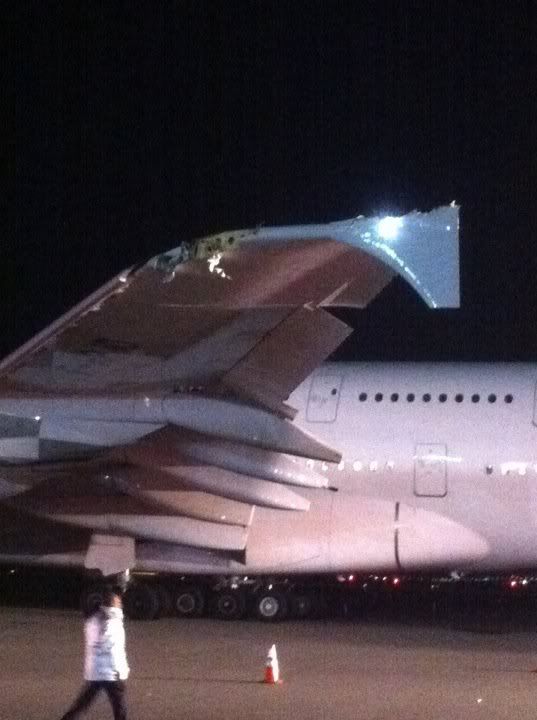
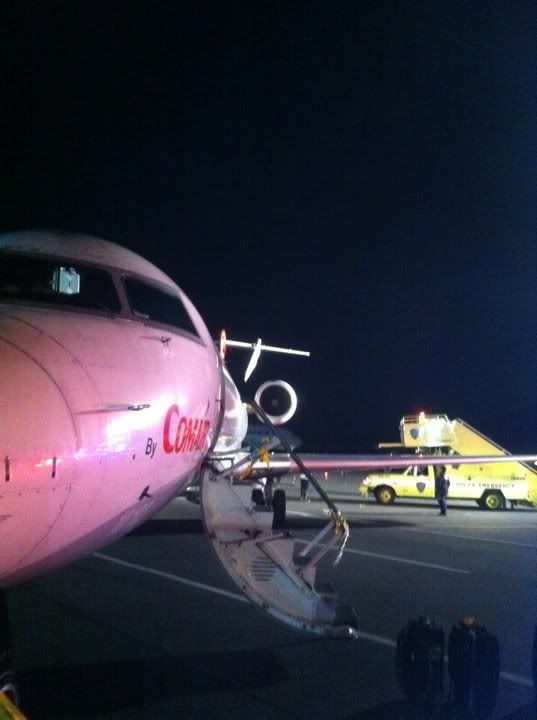
This happened last night, when an Air France A380 was trying to depart JFK for Paris and its left wingtip caught the tail of a Comair RJ. No injuries reported, so that's good, though if I was in the RJ cockpit I'm thinking the seat upholstery would likely need to be replaced. It does makes me take the "please keep your seatbelts on until the plane has arrived at the gate" warnings a little more seriously too.
How did this happen? I'm sure there will be a report, but right away I see there are a few things of interest:
- The A380 seemed to be going faster than a normal taxi speed, but it also seems like the video might be sped up a bit.
- It was at night, so visibility wasn't the greatest.
- The widest runways at JFK are 200 feet across.
- The wingspan of the A380 is just over 261 feet.
Looks like they might want to revise the procedures for handling the A380 when other aircraft are in the neighborhood. From the way it completely manhandled the RJ, I'm not sure the A380 would even notice if they ran over our Citation 550. I bet I would though, so I'm making a mental note to give it at least 131 feet of lateral separation on the ramp if I ever come across one.
Update: Here's the ATC audio, and a couple of pics
Wednesday, March 16, 2011

Friday, March 11, 2011


My heart goes out to those people affected by the earthquake (and subsequent tsunami) off the coast of Japan.
FlightGlobal is reporting that Japan's Sendai airport is detroyed by the tsunami.
Lots of pics here:
http://www.abc.net.au/news/photos/2011/03/11/3161999.htm
The NY Times also has some breathtaking pictures of the destruction.
Last night's return flight to Toronto was a bit more interesting. A low-level jetstream was causing severe turbulence in a line south of Rochester NY to Buffalo NY, and we were flying right along the northern edge of it. We didn't get anything too bad, but I kind of hate sitting in solid cloud for 2 hours, waiting for the bumps to get bumpier. I was a bit under the weather so Kitsch flew us home. The ceiling in Toronto was better than forecast, it was 400' and 5 miles visibilty while we were expecting 200' (or lower) and 1/2 a mile vis, so it worked out fine.
We landed on runway 05, which is my favorite in Toronto because a) it's close to our home base FBO and b) it has pretty wickedly bright runway lighting. Our rules say that we can continue our approach if we see the runway lights, and I have yet to encounter clouds in Toronto that were so thick the runway lights weren't visible through them. I mean, if we did we'd go around and either try again or go somewhere else, but it has yet to happen.
I started the video close to the decision height - the previous 2 hours was solid cloud with occasional rain and that's not very fun to watch.
You can hear the GPWS (ground proximity warning system) voice call "five hundred" (feet above ground) about 20 seconds into the video.
Oh yeah - my camera's batteries croaked just as we were decelerating on the runway, but you get the idea.
//I'll work on a non-landing-video post today.
Wednesday, March 09, 2011
By request, here's a video of our ILS into Boston this morning. select 720p and embiggen it to fullscreen for maximum fun. The weather was fine - 2,900' overcast with decent visibility underneath - but a gusty crosswind from the right kept it from being boring. This is runway 04R. They were using runway 09 to depart airplanes, so from time to time you might see other airplanes blasting off across our runway from left to right.
Kitsch hand-flew the approach, I played on the radios.
For those of you who care - there are 4 lights just to the left of the runway, called PAPI lights. They are used when flying the visual approach - if you are on the correct glide path, two of the lights will appear white, and 2 of them will appear red. If you see more white lights, you are a little high, and if you see more red lights, you are a little low. An ILS approach may have a slightly different touchdown point on the runway, and the PAPI lights may indicate a different picture than the instruments on board the airplane - for example, on runway 05 going into Toronto, the PAPI lights will show 3 or 4 red lights while the Instrument Landing System shows us as being on the glidepath. If we are flying the visual approach, we'll fly the PAPI lights, and if we are flying the ILS we'll fly the electronic glideslope indication in our airplane.
A person in the comments section asked about the construction cranes on an island just before we landed at Boston - they are actually loading cranes used to put shipping containers onto ocean-going vessels. The person expressed surprise that they are allowed to be placed so close to the runway. As far as the cranes - they are maybe 50 - 70' above the water, and maybe 1 1/2 miles from the threshold - you can hear the radar altimeter lady say "500" as we are passing them, so she's telling us we are 500' above the ground at the time. If you are low enough to hit the cranes at 1 1/2 miles back, you have bigger problems than the cranes, like hitting the water. If you stay on the correct slope, you will have plenty of vertical clearance over them - at a 3 degree glideslope, you will be 300' above the runway for every mile back you are.
If we are taking off, we are assured of vertical clearance over any obstacles in our departure path as long as we adhere to the appropriate departure procedures, which is normally a climb gradient of 200' per horizontal nautical mile. In this case, the required climb gradient on runway 22L (the reverse heading of the runway we landed on) is "standard if tower reports no tall vessels in the departure area". However, on runway 22R, which is just a couple of hundred feet away from it (and in fact a bit closer to the loading cranes), you need a higher climb gradient than normal to assure obstacle clearance. In that case, you need to climb at 320' per nautical mile until you are 600' above sea level. If we were departing on that runway and the weather was bad, we'd consult our airplane charts to make sure that at our takeoff weight we could climb at that climb gradient even if we lost an engine right as we took off.
That actually would be a good subject for a pilot-geek-post - the things we do in low visibility conditions to assure obstacle clearance. If the weather is good, we can just turn to avoid things like cranes and buildings and mountains, but when we can't see outside due to fog etc, we follow a whole complicated set of rules, and the math gets a lot more in-depth (we have an app for that :p). I will start on a post like that some time in the near future.
Anyway, this morning was a nice, routine flight. Now off to a yummy seafood place for lunch! :)
Saturday, February 19, 2011
For my second video of the day, here's one where a flight instructor intentionally shuts the engine down on a student for forced approach practice. I think I'd probably beat the instructor unconscious after the landing - shutting down a healthy engine is just plain retarded. What if another airplane was on the runway or a moose ran out, or what if the student screwed up the forced approach? The mind boggles.
Tuesday, February 15, 2011
Well, I certainly didn't like that. Blogger toasted my blog for about a day - apparently I did something to set off the spam alert. My guess is that it didn't like me logging in from Toronto, then Quebec City, then Montreal within a few hours. Anyway, I begged shamelessly to have it restored. And so it is! The first thing I did was make a complete backup of this blog, which I had never done before. You know, just in case. More flying stuff coming up soon!
Tuesday, February 01, 2011
Here's the other ILS we did yesterday. This one was considerably less challenging from a technical perspective - the ceiling was 1200' and the visibility was 2 miles. The only notable thing was the direct crosswind from the left at 25 knots, and you can see a classic crosswind landing technique being applied here - drop a wing into the wind, keep aligned with the runway using rudder. Touch down on the left main gear first, then the right main gear, then the nose gear. Other than that, not much to it. Like yesterday's post, a few minutes of boring "solid IMC" was removed from the middle of the clip.
Now onto the gross stuff - I have two things that may cause you discomfort. They are both kinda gross, you have been warned!
The first one happened last night - I got back from supper and passed out on my hotel room couch while watching Oprah reruns, and woke up around 1am. I decided to reposition to my bed, but first I had to brush my fangs. I didn't want to turn the lights on and destroy my melatonin buildup, so I fumbled around in my overnight bag for my toothbrush.

Instead, I found my razor. If you look closely, you'll see that I actually peeled back a long thin strip nearly all the way to my first digit. Atomic hangnail! So much blood! I feel bad because the people will likely have to steam-clean the carpet before they can use the hotel room again.
Now for the other disturbing thing, and it's mostly because it showcases my bloated ego.

I found these at a pilot supply shop at my current airport. After chuckling and thinking "who on earth would buy these", I immediately bought them. Lots of people have what it takes to be a Captain, but only a certain few have what it takes to be a dictator! I'm officially a terrible person :)
Subscribe to:
Posts (Atom)
